Why Inventory Management Is Your Most Underrated Growth Lever
Stockouts are the silent killer of Amazon businesses. A single stockout on a top-ranking ASIN can cost weeks of rank recovery time and thousands in lost sales. Conversely, excess inventory ties up capital in storage fees and increases financial risk. Getting inventory right isn't just operational - it's a core growth strategy.
When you go out of stock, Amazon doesn't just stop showing your ad - it starts ranking your ASIN lower organically, because zero sales velocity is a negative signal. Brands typically see a 40 to 60% organic rank drop after 7+ days out of stock, and full rank recovery can take 4 to 8 weeks of consistent sales post-restock.
Step 1: Know Your True Lead Time
Most sellers calculate lead time as "production time + shipping time." This underestimates actual lead time by 30 to 50%. Your true lead time includes: supplier confirmation and production time, quality inspection, freight forwarding pickup, ocean/air transit, customs clearance, Amazon receiving and check-in, and the buffer for unexpected delays at any stage.
For most sellers importing from Asia to India or the US, a realistic total lead time is 45 to 75 days. Plan inventory replenishment using this full number, not the optimistic one.
Step 2: Calculate Your Reorder Point Properly
Your reorder point is the inventory level at which you place a new purchase order. The formula: Reorder Point = (Average Daily Sales × Lead Time Days) + Safety Stock.
Safety stock accounts for demand spikes and supply delays. A conservative safety stock is 25 to 30% of your lead time demand. So if you sell 20 units/day and your lead time is 60 days, your base demand is 1,200 units. Add 25% safety stock (300 units) and your reorder point is 1,500 units - meaning you place a new order when your available inventory hits 1,500 units.
Step 3: Demand Forecasting - Don't Fly Blind
Flat-line demand forecasting (assuming tomorrow looks like today) works fine in stable categories but fails badly for seasonal products, products with growing velocity, and any product affected by external trends. Use Amazon's own demand forecast in Seller Central as a baseline, but supplement it with: your historical sales data by week, category seasonality trends, planned PPC spend increases, and any external marketing campaigns.
Tools for demand forecasting:
- Inventory Planner - the most widely used third-party forecasting tool; integrates with Amazon and Shopify
- Linnworks - strong for multi-channel sellers managing Amazon + own website
- Skubana/Extensiv - enterprise-grade for high-SKU catalogues
- Seller Central's built-in forecasts - useful baseline, but conservative; adjust upward for growth-phase products
Step 4: Managing Amazon's Inventory Performance Index (IPI)
Amazon uses an Inventory Performance Index (IPI) score to determine how much warehouse space you're allocated at FBA. Sellers below the IPI threshold (currently 400) face storage limits. Key IPI drivers: excess inventory percentage, sell-through rate, stranded inventory, and in-stock rate for top ASINs.
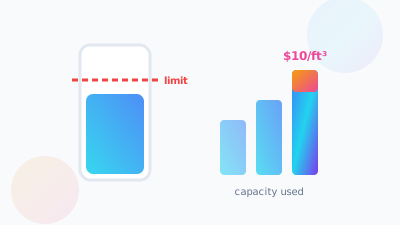
Keep excess inventory (units with 90+ days supply) below 10% of your total FBA inventory to protect your IPI score. For slow-moving ASINs, consider price drops, removal orders, or FBM conversion before long-term storage fees hit.
Instead of sending all inventory in one large shipment, split each reorder into two shipments: one by air freight (expensive but fast, arriving 4 to 6 weeks before stockout) and one by sea freight (cheaper, arriving just as the air freight is running out). This costs slightly more per unit in freight but eliminates stockout risk and reduces the capital tied up in excess inventory simultaneously.
Step 5: Handling Seasonal Demand Spikes
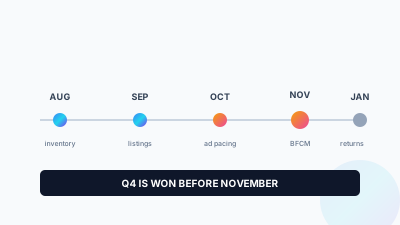
For categories with significant seasonal demand (gifting categories in Q4, fitness equipment in January, outdoor products in summer), you need to start inventory planning 4 to 5 months before peak season. Amazon's receiving queues get severely congested in October to November; if your inventory doesn't arrive by mid-October, you risk missing the entire Q4 peak.
Frequently Asked Questions
Brands typically see a 40 to 60% organic rank drop after 7 or more days out of stock, and full recovery can take 4 to 8 weeks of consistent sales once you restock. Amazon reads zero sales velocity as a negative signal, so it ranks the ASIN lower organically rather than just pausing your ads.
Use (Average Daily Sales x Lead Time Days) + Safety Stock, with safety stock at a conservative 25 to 30% of lead time demand. Selling 20 units a day on a 60 day lead time gives 1,200 units of base demand, plus 300 units of safety stock, so you reorder at 1,500 units available.
Sellers below the IPI threshold, currently 400, face storage limits on how much warehouse space Amazon allocates them. The main drivers are excess inventory percentage, sell-through rate, stranded inventory, and in-stock rate on top ASINs. Keeping excess inventory (units with 90 or more days of supply) below 10% of total FBA inventory protects the score.
Start 4 to 5 months before peak season for any category with real seasonal demand. Amazon's receiving queues get severely congested in October and November, so if your inventory doesn't arrive by mid-October you risk missing the entire Q4 peak. Build planning around your true lead time, realistically 45 to 75 days importing from Asia.
Struggling With Stockouts or Excess Inventory?
We help Amazon brands build inventory systems that eliminate stockouts without tying up excess capital. Book a free consultation to review your current inventory strategy.
Get My Free Inventory Review →