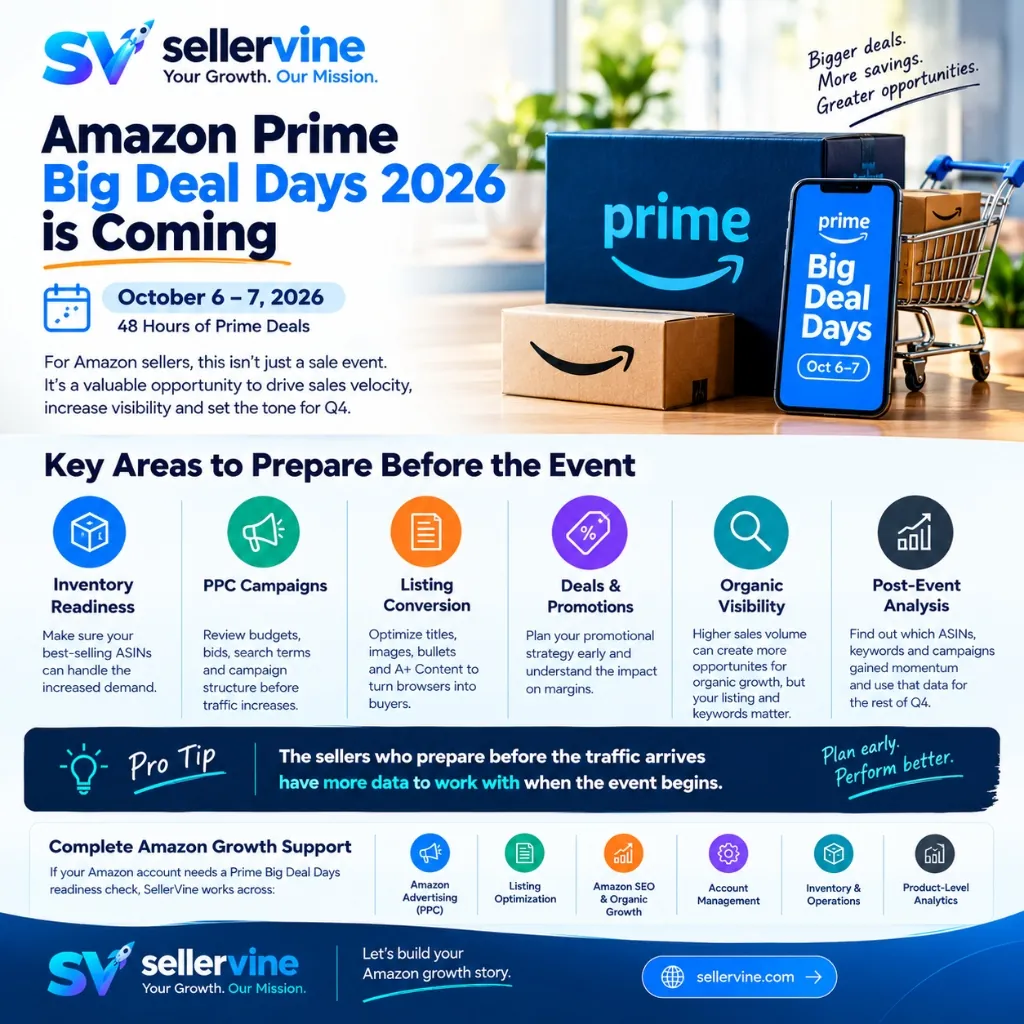
Amazon's flagship Fall event, Prime Big Deal Days, takes place on October 6 & 7, 2026. Independent small-to-medium businesses generated record-breaking volume in recent Prime events, and this October tentpole officially unlocks the Q4 holiday retail surge. Single-channel PPC campaigns that rely solely on keyword bidding now face 40% to 75% higher Cost-Per-Clicks (CPCs) and risk mid-day budget exhaustion. Advertisers who coordinated Sponsored Products, Sponsored Brands, and Display ads achieved a verified 137% increase in sales compared with their own pre-event baseline week. This comprehensive operational blueprint details the exact full-funnel, B2B procurement, and algorithmic cost-control architecture required to scale profitability during Prime Big Deal Days 2026.
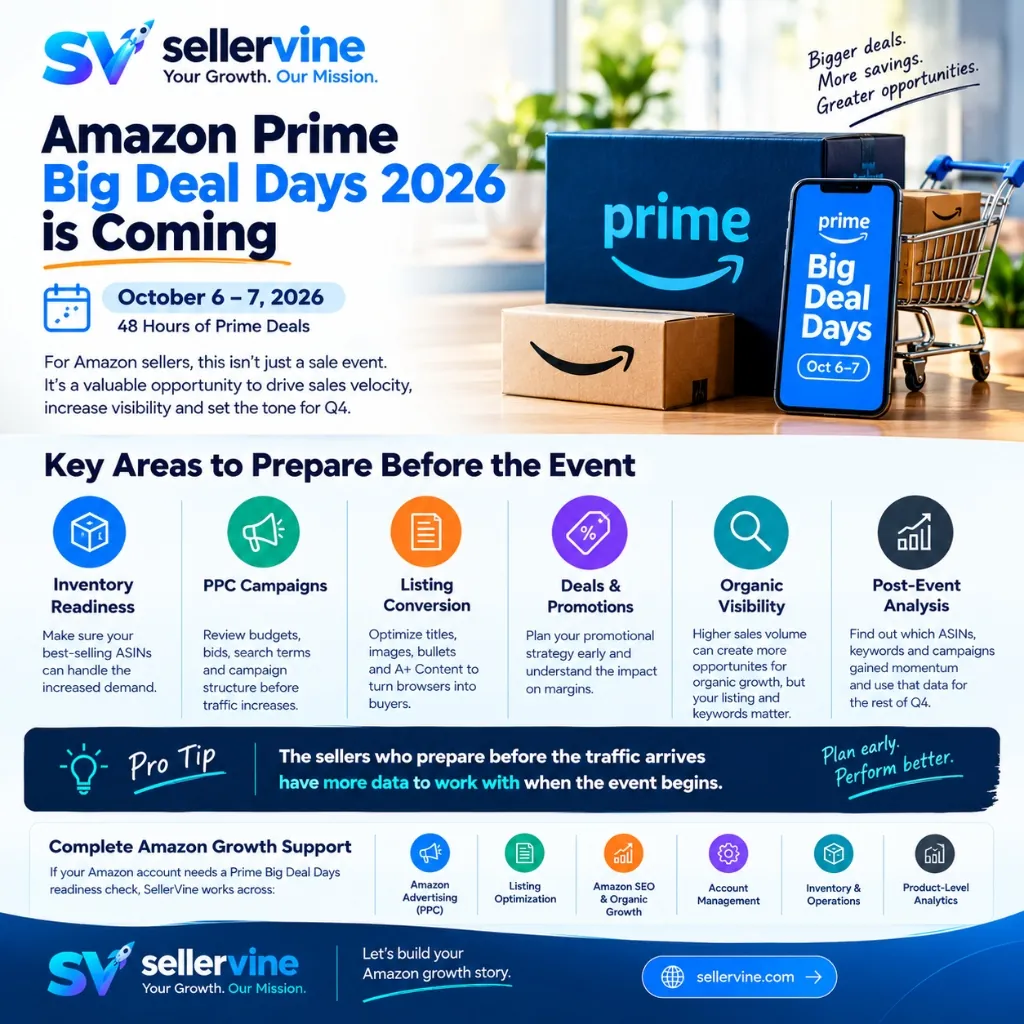
"The sellers who prepare before the traffic arrives have more data to work with when the event begins. Plan early. Perform better." With Prime Big Deal Days active this week across the US, UK, Canada, and Europe, executing across all 6 readiness pillars establishes the baseline needed to out-convert reactive competitors.
1. Building Your Prime Big Deal Days Full-Funnel Architecture
Every tentpole event on Amazon generates an influx of high-intent traffic, but many brand owners mistake high traffic for guaranteed margin. The operational truth of Prime Big Deal Days is that auction density surges exponentially. When thousands of competitors compete for identical search terms like "wireless earbuds" or "collagen peptides", bidding floors rise sharply within minutes.
Brands that treat Prime Big Deal Days as a localized 48-hour coupon blitz often burn capital rapidly. The brands that achieve profitable market share treat this event as an integrated customer acquisition mechanism across three core formats:
- Sponsored Products (The Conversion Engine): Capturing high-intent shoppers directly within search result grids and product detail page carousels who are ready to purchase immediately.
- Sponsored Brands & SB Video (The Consideration & Differentiation Driver): Establishing prominent visual positioning above organic search results, introducing brand narrative, and steering shoppers toward high-margin catalog bundles in curated Brand Stores.
- Display Ads & Amazon DSP (The Retargeting & Pre-Event Reach Lever): Expanding brand reach outside Amazon prior to the event, re-engaging shoppers who viewed product detail pages over the prior 30 days, and defending your brand from aggressive conquesting.
Internal Amazon retail performance data underscores this reality: advertisers who deployed Sponsored Products, Sponsored Brands, and Display ads simultaneously during the July 2025 Prime Day event saw a 137% increase in sales compared with their own pre-event baseline week. Furthermore, combining Sponsored Brands video and display formats drove an average 39% sales outperformance over the baseline week.
The explanation lies in consumer psychology during high-velocity retail events. Prime Big Deal Days shoppers rarely follow a single-click purchase path. Shoppers browse categories days in advance, assemble wish lists, evaluate competitor pricing, and compare reviews. A single Sponsored Products ad appearing at the exact moment of search is rarely enough to beat a competitor whose brand the customer has already encountered via off-Amazon display, streaming TV, or high-impact video creative.
Showcasing Top Products & Deal ASINs
Capital allocation must follow strict SKU prioritization. Launching ad spend evenly across an entire 200-SKU catalog dilutes media impact. Prime Big Deal Days advertising requires dividing your catalog into three distinct tiers:
- Tier 1: Deal Heroes (Lightning Deals, Best Deals, Prime Exclusive Discounts): These items feature official deal badges that elevate click-through rates (CTR) and conversion rates (CVR). Allocate 60% of your total ad budget here. Pair aggressive Top of Search placement modifiers (+50% to +100%) with Sponsored Products video to dominate above-the-fold space.
- Tier 2: High-Margin Organic Drivers: SKUs with strong review velocity (4.3+ stars, 500+ ratings) that lack official discounts but boast superior unit economics. Utilize these to harvest organic rank lift triggered by high sales velocity leading into Q4.
- Tier 3: Long-Tail Catalog Defense: Defensive product targeting (PAT) campaigns placed directly on your own detail pages to prevent predatory competitors from stealing your traffic.
2. The Three-Phase Budget & Bid Pacing Architecture
The single most destructive operational mistake on Prime Big Deal Days is the 10:00 AM Budget Death Trap. An advertiser establishes a daily budget of $2,000 based on standard trailing averages. By 10:15 AM EST on Day 1 (October 6), surging traffic and elevated CPCs completely consume the budget cap. Amazon algorithmically disables the campaigns. For the remaining 14 hours of peak consumer shopping, the brand's products disappear entirely from search results, gifting market share to competitors.
To avoid this failure state, SellerVine implements a rigorous Three-Phase Budget Pacing Architecture.
"Think about your budget and bids holistically and look at the bigger picture. Tentpole events like Prime Big Deal Days are an opportunity to scale strategically and help ensure you’re not missing out on increased traffic and eventually on sales growth and organic uplift. Traffic doesn't spike before the event, but it does grow. And if you’re already hitting your budget cap, you’ll miss the real peak when it matters most: during the event. Check for budget caps and review your campaigns regularly. Are any marked 'limited by budget'? If yes, increase your budget or you’ll risk your products not showing to customers during the event’s busiest hours. Start scaling budgets three to five days ahead and go for 20-30% increments, giving your campaigns time to adjust. For high-performing campaigns, keep budgets open, especially for branded and non-branded search campaigns with strong ROAS. This helps ensure your ads keep running when traffic surges."
Phase 1: The Pre-Event Escalation (October 1 to October 5)
Shoppers begin active product discovery days prior to Prime Big Deal Days, adding prospective items to carts and wish lists. Conversion rates temporarily drop during this window because consumers are waiting for October 6 deal pricing to go live. Cutting ad spend during this pre-event window is a critical error: if you pause advertising, shoppers won't add your ASINs to their carts ahead of the sale.
- Budget Scaling: Beginning 3 to 5 days prior to kickoff, scale campaign daily budgets by 20% to 30% increments each day. This gives Amazon's machine learning pacing algorithms time to adjust baseline spend velocity without hitting emergency throttle limits.
- Targeting Expansion: Seed Keyword Groups in Sponsored Brands and Display to identify rising search queries.
- Brand Store Audits: Verify that your dedicated Prime Big Deal Days subpage is published, approved by Amazon moderation, and linked in all top-of-search Sponsored Brands assets.
Phase 2: Peak Tentpole 48-Hour Execution (October 6 & 7)
During the 48-hour event, shopping traffic peaks and Conversion Rates double or triple. A product that normally converts at 11% can routinely hit 26% to 32% during active Prime Big Deal Days windows. This conversion rate expansion justifies higher nominal CPCs.
- Open Budgets on High-ROAS Campaigns: For branded defense, exact-match hero search terms, and deal-badged ASINs, keep budgets uncapped. If a campaign is generating a 4.5x ROAS with strong stock availability, capping spend at an arbitrary threshold forfeits pure profit.
- Hourly Telemetry with Amazon Ads Agent: Monitor campaigns across impressions, clicks, and spend velocity. Immediately identify any campaign marked "Limited by Budget" and elevate caps before impressions stall.
- Strategic Placement Modifiers: Apply aggressive modifiers (e.g., +40% to +85%) to Top of Search (First Page). During tentpole events, shoppers scroll less and buy faster; capturing position 1 and 2 drives superior conversion velocity compared to rest-of-search.
Phase 3: The 14-Day Post-Event Re-Engagement Window (October 8 to 21)
Prime Big Deal Days does not conclude when the clock strikes midnight on October 7. The post-event window represents one of the most profitable advertising opportunities of Q4:
- Remarketing to Glance Views: Deploy Amazon DSP and Sponsored Display audiences to retarget consumers who viewed your product detail pages during October 6 & 7 but did not complete a purchase. Many shoppers hesitate during the rush, then return to complete the order once the event frenzy settles.
- Capturing Gift Card & Trade-In Volume: Millions of dollars in Amazon gift cards and account balances are redeemed in the days immediately following the event. Competitors often slash ad budgets to zero post-event, causing auction CPCs to plummet. Brands that maintain active campaigns capture this secondary demand at significantly reduced ad costs.
- B2B Restock & Procurement Approval: Corporate buyers who placed initial orders during the event frequently follow up with large replenishment orders once purchase orders are cleared by finance teams.
3. Creative Diversification: Video and Generative AI Acceleration
Static imagery alone can struggle to capture attention in modern search feeds. In 2026, motion creative and immersive lifestyle assets are essential tools for driving customer engagement.
Sponsored Products Video: The Native Search Advantage
One of the most powerful advertising additions is Sponsored Products video (live in the United States). Historically, video advertising was restricted to Sponsored Brands, requiring separate creative review and brand-level budgeting. Sponsored Products video now integrates video assets directly into your existing Sponsored Products campaigns without requiring extra campaign structures or supplementary budgets.
Because SP Video ties directly into your existing keyword and product targeting controls, it displays single-product motion creative directly within organic search rankings. This format highlights product functionality, demonstrates real-world scale, and delivers instant social proof, driving significant increases in Detail Page View Rates (DPVR).
Over 80% of Prime Big Deal Days search traffic occurs on mobile devices, and most shoppers browse with sound muted. Follow these four rules for video assets:
1. Product in the First 2 Seconds: Display the physical hero product immediately, do not open with a generic logo splash or prolonged narrative fade-in.
2. High-Contrast Text Overlays: Call out primary product differentiators (e.g., "100% Waterproof", "40-Hour Battery") in bold, legible typography positioned in the upper two-thirds of the viewport to prevent overlap with UI playback icons.
3. Sound-Off Comprehension: Ensure the visual demonstration conveys complete utility even with audio completely muted.
4. Seamless Loop: Keep video length between 6 and 15 seconds with a smooth visual loop that encourages continuous viewing.
Generative AI Acceleration: Video Generator & Image Generator
Producing dozens of lifestyle images and professional videos traditionally required months of production planning and heavy agency fees. Amazon's native AI creative toolsuite eliminates these bottlenecks:
- Video Generator: Accessible inside the Creative tools tab in Amazon Ads Agent, this tool converts static product white-background images into 6-to-15 second, professional-grade lifestyle video ads with a single click. It applies realistic motion algorithms to place products in authentic environments (e.g., a coffee machine steaming in a modern kitchen).
- Image Generator: Enter an ASIN, and the generative engine synthesizes tailored, photo-realistic lifestyle scenes that reflect seasonal Fall themes, indoor cozy settings, or modern home aesthetics. These assets can be deployed across Brand Store headers, Sponsored Brands custom images, and DSP creative cards.
- Amazon Ads App on Canva: Streamline multi-asset production with native Amazon Ads templates in Canva, featuring automated real-time policy checks that ensure your creative meets resolution, margin, and copy compliance guidelines before publishing directly to your asset library.
4. Brand Store Conversion Architecture: The High-Velocity Storefront
During Prime Big Deal Days, sending high-cost Sponsored Brands traffic directly to an uncurated catalog homepage wastes valuable advertising dollars. Directing shoppers to a generic collection forces them to search for active discounts, increasing friction and bounce rates.
The Dedicated Prime Big Deal Days Event Page
Amazon's automated Store tools allow brands to generate a dedicated Prime Big Deal Days Event Page with one click. The system curates all active Prime Exclusive Discounts, Lightning Deals, and top-rated catalog items onto a dedicated storefront destination. Merchandising rules for this page include:
- Above-the-Fold Deal Hero: Place your primary discount hero banner directly at the top of the mobile viewport, highlighting your deepest discount percentages.
- Product Selector Interactive Quiz: Implement the interactive Product Selector widget. When overwhelmed shoppers arrive looking for skincare, supplements, or technical gear, the guided quiz asks 2-3 preference questions and immediately presents the single best-matching SKU. This interactive personalization reduces decision fatigue and can boost storefront conversion rates by up to 40%.
- Shoppable Lifestyle Images: Deploy interactive shoppable images where lifestyle photography features clickable pins. Tapping a pin reveals product pricing, review stars, and an immediate "Add to Cart" button without requiring the shopper to navigate away from the visual story.
- Mobile Viewport Optimization: Verify that mobile font sizes remain above 16px, navigation sub-tabs are clearly organized, and banner graphics are designed vertically rather than as horizontally compressed desktop assets.
5. The B2B Goldmine: Capitalizing on Amazon Business Procurement
One of the most overlooked growth channels during Prime Big Deal Days is enterprise procurement. This event is no longer just a consumer event; enterprise purchasing managers, office administrators, healthcare facility directors, school districts, and government procurement officers actively hunt for volume deals during this window heading into Q4 budget exhaustion.
The unit economics of B2B buyers on Amazon Business provide compelling margin advantages over typical retail shoppers:
- 70% Larger Unit Quantity per Order: B2B buyers purchase cases, multi-packs, and organizational replenishments rather than single units.
- 50% Lower Return Rate: Institutional purchases are planned and deliberate, significantly reducing the return processing fees that erode Fall margins.
- 3x Higher Conversion Rate: Business buyers demonstrate a purchase conversion rate three times higher than consumer shoppers upon viewing a product detail page.
- Global Footprint: Amazon Business serves over 8 million organizations worldwide across the United States, Canada, Mexico, the United Kingdom, Germany, France, Italy, and Spain.
Two Core B2B Advertising Strategies
Enterprise brands should deploy a two-pronged B2B media buying framework:
| B2B Strategy | Mechanism | Optimal Use Case | Performance Benchmark |
|---|---|---|---|
| Amazon Business Placement Adjustments | Bid adjustment setting within standard Sponsored Products campaigns (adjustable from +1% to +900%). | Capturing B2B buyers on standard retail consumer campaigns without creating new campaign structures. | Recommended start: +20% to +120% bid boost on primary ASINs. Elevates B2B win rates instantly. |
| B2B Exclusive Campaigns | Dedicated, isolated Sponsored Products and Sponsored Brands campaigns served strictly to verified Amazon Business accounts. | Products with commercial utility, bulk packaging, janitorial/office relevance, or tiered quantity discounts. | +120% increase in sales on Amazon Business compared to shared campaigns with identical ASINs. |
Phased B2B Budget Allocation
Do not depend on consumer budgets to capture business buyers. Establish dedicated budget buckets for Amazon Business campaigns and phase them across three key timeframes:
- Pre-Event (October 1 to 5): Prime departmental awareness. Corporate buyers often require internal manager approvals or formal purchase order authorizations before executing transactions.
- Event Window (October 6 & 7): Capture immediate credit card and corporate purchasing account transactions.
- Post-Event (October 8 to 21): Re-engage corporate accounts. Business procurement cycles frequently operate on a 10-to-14 day delay as finance teams approve bulk invoices post-tentpole.
6. Algorithmic Cost Controls and Placement Bidding Dynamics
Managing high-velocity bids manually across thousands of keywords during a 48-hour event is impractical. Successful execution relies on configuring Amazon's native algorithmic bidding safeguards.
Automated Cost Controls in Display and Sponsored Brands
Within Sponsored Brands and Display ad campaigns, activating Cost Controls allows Amazon's machine learning models to adjust bids dynamically in real time while enforcing target efficiency thresholds.
According to Amazon global performance data, advertisers that utilized algorithmic cost controls in display campaigns achieved an average 2.6 times uplift in ad-attributed sales per campaign compared to campaigns relying on static manual bidding. The algorithm automatically increases bids during high-conversion peak hours (e.g., 2:00 PM to 8:00 PM EST) and reduces bids when shopping cart conversion propensity wanes, preserving ad spend.
Keyword Groups & Audience Bid Boosting
Simplify campaign management by deploying Keyword Groups across Sponsored Brands and Display. Rather than managing dozens of fragmented single-keyword ad groups, Keyword Groups dynamically group relevant semantic queries, allowing you to scale coverage while maintaining bid governance.
Combine this with the New-to-Brand (NTB) Shoppers Audience Bid Boost in Sponsored Brands. This capability allows you to apply automated percentage multipliers (e.g., +30%) specifically when Amazon's identity graph recognizes a shopper who has not purchased from your brand in the trailing 12 months. You pay competitive rates for conquesting new shoppers while avoiding over-bidding on existing loyal customers.
Aggressive Negative Keyword & ASIN Sculpting
During Prime Big Deal Days, search query noise expands dramatically. Consumers use vague exploratory search terms like "prime big deal days deals", "holiday gifts under 50", or "cheap electronics". These broad terms carry exorbitant CPCs and very low conversion intent for specific brand catalogs.
- Negative Exact Brand Mismatches: Add negative exact matches for your own brand in non-branded discovery campaigns to prevent internal cannibalization.
- Negative ASIN Harvesting: Review search query reports from prior tentpole events. Identify low-priced competitor ASINs where your conversion rate is below 3% and negative-match them in Product Attribute Targeting (PAT) campaigns.
- Out-of-Stock Variation Negatives: If specific color or size variations stock out during the event, immediately add their specific identifiers to negative targeting to stop wasted clicks on broken listings.
7. Global Marketplace Expansion: Cross-Border Tentpoles
Prime Big Deal Days is an international phenomenon spanning over 20 marketplaces. For brands established in the United States, expanding into Europe, Japan, Canada, and Mexico offers significant opportunities for incremental growth heading into Q4.
Centralized Global Management via Amazon Ads Agent
Managing campaigns across multiple currencies, time zones, and languages can quickly become overwhelming. Amazon Ads Agent consolidates international sponsored ads management into a single interface:
- Automated Keyword Localization: Translating keywords literally often misses regional search habits (e.g., "trainers" vs. "sneakers" in the UK vs. the US). Amazon Ads Agent applies localized retail shopping queries to ensure native search alignment.
- Multi-Country Campaign Synchronization: Replicate high-performing domestic campaign structures across the UK, Germany, France, Italy, Spain, and Japan with adjusted regional bid caps.
Tax & Regulatory Considerations (EU VAT & Digital Ad Taxes)
When expanding into European marketplaces, advertising economics must factor in regional statutory overhead:
- Value Added Tax (VAT): Ad spend and gross selling prices in Europe are subject to VAT (typically 19% to 22%). Failure to account for net-of-VAT revenue in your target ACoS/ROAS formulas will lead to unexpected margin compression.
- Digital Services Taxes (DST): Several European jurisdictions (including the UK, France, Italy, and Spain) levy regulatory digital advertising taxes (ranging from 2% to 3%) that are added to media invoices. Factor these fees directly into your break-even TACoS models.
8. The 12-Dimension Strategy Matrix: Comparing Approaches
To visualize the operational gap between standard advertising habits and an advanced full-funnel strategy, examine how execution differs across twelve core capabilities:
| Strategic Dimension | Amateur / Deal-Only Approach | Standard PPC Auto-Pilot | SellerVine Advanced Full-Funnel Architecture |
|---|---|---|---|
| 1. Media Format Mix | Sponsored Products only | SP + basic static Sponsored Brands | Unified SP, SP Video, SB Video, Display & Amazon DSP (+137% lift) |
| 2. Budget Pacing Strategy | Static daily cap; shuts down before noon | Manual mid-day budget top-ups | 3-Phase Ramp (20-30% daily increments 3-5 days prior; uncapped on winners) |
| 3. Video Integration | None; static imagery only | Single SB Video linked to PDP | Native SP Video + SB Video linked to custom Brand Store deal hub |
| 4. Creative Production | White-background studio renders | Manual agency assets (high cost/slow) | Amazon Video & Image Generator + Canva integration in minutes |
| 5. Storefront Destination | Standard homepage catalog | Generic category subpage | Dedicated AI Prime Big Deal Days Page + Product Selector quiz |
| 6. B2B / Amazon Business | Ignored completely | Default consumer campaign overlap | Dedicated B2B Exclusive campaigns (+120% sales) + placement boosters |
| 7. Bid Optimization | Static manual keyword bids | Basic dynamic bids (down only) | Algorithmic Cost Controls (2.6x lift) + NTB audience bid boosts |
| 8. Placement Modifiers | 0% across all placements | Modest Top of Search (+15%) | Aggressive Top of Search (+50% to +90%) + Amazon Business (+120%) |
| 9. Post-Event Strategy | Campaigns paused immediately | Budgets slashed by 80% | 14-Day retargeting window for glance views, gift cards & B2B replenishment |
| 10. Negative Match Defense | No negative maintenance | Infrequent search term harvesting | Real-time negative sculpting on out-of-stock variations & vague terms |
| 11. International Reach | Single domestic marketplace | Direct copy-paste campaigns | Centralized global orchestration with localized semantic keywords |
| 12. Attribution Model | Same-day 14-day ACoS only | Basic blended ROAS | TACoS governance, New-to-Brand (NTB) CAC & 12-month LTV modeling |
9. Unit Economics, Break-Even TACoS & 12-Month LTV Modeling
Evaluating Prime Big Deal Days advertising performance strictly through same-day Advertising Cost of Sales (ACoS) is an outdated approach. Tentpole events generate valuable customer relationships that lead directly into Black Friday, Cyber Monday, and Q4 holiday gifting.
When a consumable or repeat-purchase brand acquires a customer on Prime Big Deal Days, that customer frequently subscribes via Subscribe & Save or repurchases throughout Q4. A campaign operating at a 42% ACoS on October 6 may appear unprofitable in isolation. However, if 65% of those buyers are New-to-Brand (NTB) and demonstrate an average 12-month repeat order rate of 2.4 purchases, the true acquisition ROAS often exceeds 4.0x.
Use the long-term sales metrics available within Amazon Ads Agent to evaluate the true financial impact of your campaigns. These reports project 12-month customer revenue based on historical brand repurchase patterns, providing leadership teams with a clear, reliable assessment of their tentpole marketing investments.
10. Top 5 Pitfalls in Prime Big Deal Days Media Execution
Avoid these five common pitfalls to protect your capital and maximize sales volume on October 6 & 7:
- The 10:00 AM Budget Death Trap: Setting rigid daily budgets that run out before noon. Solve this by scaling budgets 20% to 30% daily prior to the event, and keeping budgets open on high-performing campaigns.
- Desktop-Biased Storefront Design: Over 80% of Prime Big Deal Days transactions occur on mobile devices. Storefront designs with tiny desktop text, cramped product grids, or horizontal banners create mobile friction. Always test your storefront layout on mobile devices first.
- Overlooking the B2B Procurement Audience: Viewing tentpole sales purely as a B2C retail event forfeits high-margin enterprise demand. Activate Amazon Business placement modifiers (+20% to +120%) and deploy standalone B2B Exclusive campaigns.
- Abruptly Pausing Post-Event Campaigns: Cutting all ad spend on October 8 misses the profitable 14-day post-event window. Keep retargeting active to capture glance views, gift card redemptions, and corporate purchase approvals.
- Ad Spending into Stockouts: Increasing ad spend on an inventory supply that cannot sustain the surge leads to mid-day stockouts. Running out of stock during a tentpole event destroys organic ranking momentum and damages your listing ahead of Black Friday. Monitor inventory burn rates in real time and reallocate budget to well-stocked alternative SKUs before units run out.
11. Step-by-Step Implementation Timeline
Execute your Prime Big Deal Days operations using this disciplined timeline:
- October 1 to 5 (Pre-Event Ramp): Complete budget scalings (+20% to 30% daily). Audit product detail pages: verify secondary image quality, bullet points, A+ Content, and mobile rendering. Confirm the dedicated Prime Big Deal Days Brand Store event subpage is approved and live with the Product Selector quiz.
- October 5 (Today - T-24h Audit): Final verification of deal submissions (Lightning Deals, Prime Exclusive Discounts). Check negative keyword sculpting to eliminate non-converting broad queries. Seed Keyword Groups in Sponsored Brands and Display.
- October 6 & 7 (Live Event Days): Conduct hourly telemetry reviews in Amazon Ads Agent. Keep budgets open on campaigns achieving target ROAS. Apply Top of Search placement multipliers (+50% to +85%) to protect top ranking positions. Check Amazon Business placement boosts (+20% to +120%).
- October 8 to 21 (Post-Event Harvest): Shift focus to post-event retargeting across glance views and cart abandoners. Harvest search term data from the event to inform ongoing Q4 PPC campaigns. Restock fast-selling inventory immediately to maintain organic rank gains for Black Friday and Cyber Monday.
Sources and data notes
Performance figures in this guide come from Amazon Ads data published for the July 2025 Prime Day event. Check the notes below before comparing them with your own results.
- Notes 1 and 2: Amazon internal data for AE, AU, BE, BR, CA, DE, EG, ES, FR, IT, JP, MX, NL, PL, SA, SE, SG, TR, UK and US. The baseline period is 29/06/25 to 05/07/25 and the tentpole period is 06/07/25 to 12/07/25. The analysis includes advertisers who spent at least $5.
- Note 3: Amazon internal data, worldwide, January to March 2025.
- Note 4: Sponsored Products video is currently available in the United States only.
- Note 5: Video Generator is available for Sponsored Brands video under Creative Studio in Australia, Canada, France, Germany, India, Italy, Japan, Mexico, Spain, the United Kingdom and the United States. In the United States it can also be accessed in Campaign Manager.
- Note 6: Image Generator is available in Australia, Belgium, Canada, France, Germany, India, Italy, Japan, Mexico, the Netherlands, Poland, Spain, Sweden, the United Kingdom and the United States.
- Note 7: Results are based on a closed beta of managed advertiser accounts, September to December 2024, in the US, EU5 and Japan.
Frequently Asked Questions (FAQ)
When is Prime Big Deal Days 2026 and how should sellers prepare right now?
Prime Big Deal Days 2026 takes place on October 6 & 7. With the event live this week, brand advertising budgets should already be scaled by 20% to 30% daily steps. Today, brand owners must verify that dedicated Prime Big Deal Days Brand Store subpages are published, negative keyword lists are active, and uncapped budgets are enabled on high-converting branded and hero deal campaigns.
Why do cross-format campaigns significantly outperform single-format Sponsored Products during Prime Big Deal Days?
Amazon retail data reveals that brands deploying Sponsored Products, Sponsored Brands, and Display ads simultaneously achieve a 137% increase in sales compared with their own pre-event baseline week. Cross-format coordination reaches shoppers across multiple touchpoints, search results, detail pages, and off-Amazon browsing, ensuring the brand captures both high-intent converters and impulse deal seekers.
What is the difference between Amazon Business placement adjustments and B2B Exclusive campaigns?
Amazon Business placement adjustments allow existing consumer campaigns to boost bids by up to 900% specifically for registered business shoppers without altering campaign structure. Conversely, B2B Exclusive campaigns are isolated, standalone campaigns shown only to verified business buyers, giving advertisers full independent control over budgets, bulk keywords, and multi-pack ASINs, delivering an average 120% sales uplift on Amazon Business.
How does Sponsored Products video differ from Sponsored Brands video during tentpole events?
Sponsored Products video integrates motion creatives directly into standard Sponsored Products campaigns without requiring extra campaign budgets or external brand registry video slots. It highlights specific product features for individual ASINs directly in search grids, whereas Sponsored Brands video focuses on brand awareness and directs traffic to curated Brand Store landing pages.
What are algorithmic cost controls and how do they benefit display and Sponsored Brands campaigns?
Cost controls allow advertisers to establish maximum target cost-per-click or cost-per-acquisition constraints while letting Amazon dynamic machine learning algorithms optimize bids automatically. Internal Amazon data indicates that advertisers utilizing cost controls in display campaigns achieved an average 2.6x uplift in ad-attributed sales compared to unassisted manual bidding.
How should enterprise brands calculate Prime Big Deal Days return on investment beyond same-day ACoS?
Enterprise brands must evaluate Total Advertising Cost of Sales (TACoS), New-to-Brand (NTB) customer acquisition volume, and projected 12-month Customer Lifetime Value (LTV). Evaluating tentpole performance solely through same-day ACoS miscalculates profitability by ignoring post-event repeat subscription velocity, organic rank elevation, and the 14-day attribution restock window heading into Q4 holiday peaks.
Ready to Scale Your Brand to Record Growth This Week?
Prime Big Deal Days execution requires deep operational experience, programmatic bidding infrastructure, and continuous campaign telemetry. Partner with SellerVine to build a customized tentpole advertising roadmap designed for sustainable, profitable scale.
Request a Comprehensive Prime Big Deal Days Audit