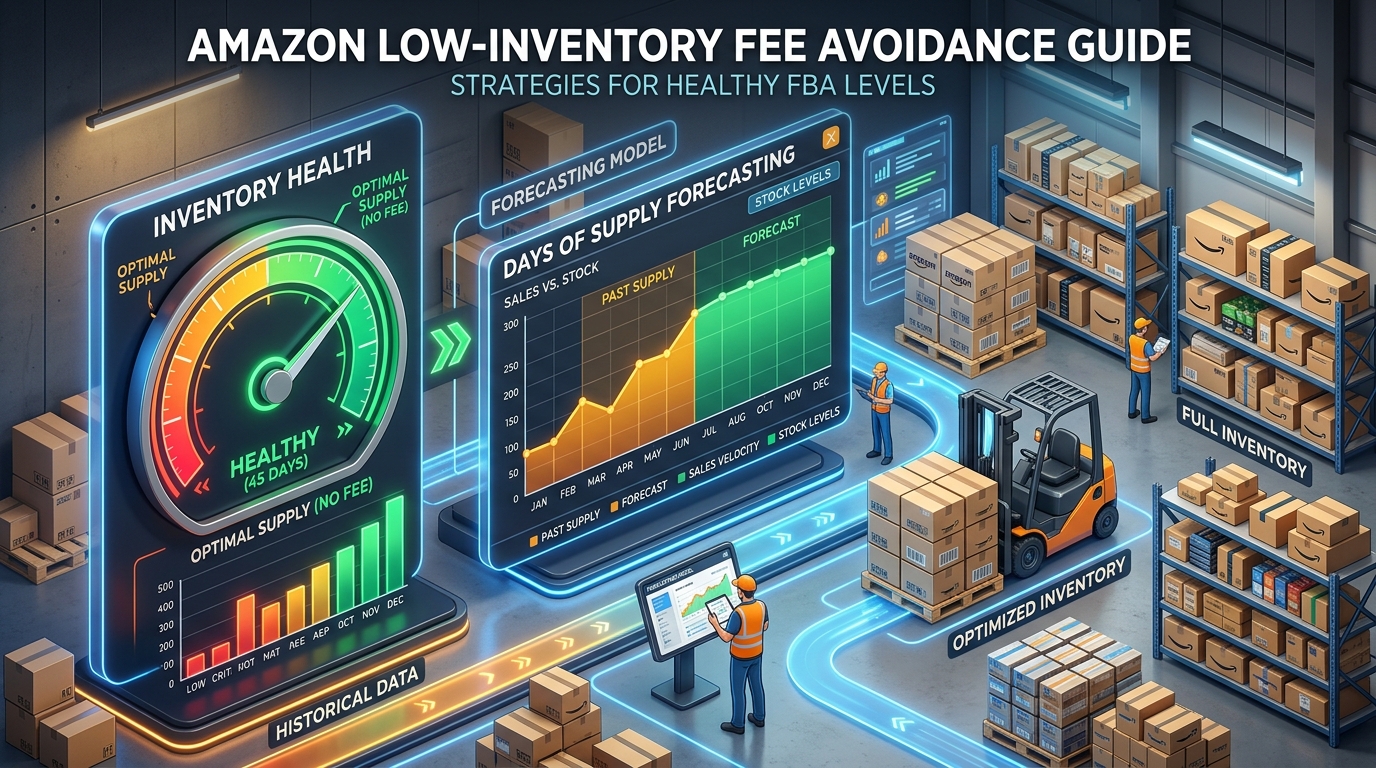
For years, the punishment for running lean on FBA inventory was implicit: lost sales, lost rank. In 2024 Amazon made it explicit - the low-inventory-level fee adds a per-unit surcharge to every outbound unit of a standard-size product whose inventory sits persistently below 28 days of supply relative to demand.
The logic from Amazon’s side: chronically thin inventory forces its network to fulfil from fewer, farther locations, raising shipping costs and slowing delivery. The consequence from yours: understocking now costs money twice - once in the sales you miss, and again as a fee on the sales you make.
The fee is entirely avoidable - several exemptions exist, and the trigger metric is precise enough to manage against. Here is exactly how it computes, who is exempt, and the replenishment design that keeps you clear without over-stocking into storage and capacity costs on the other side.
Exactly How the Fee Triggers
The fee applies per unit shipped when both of these are below 28 days for a standard-size ASIN:
- Short-term historical days of supply: inventory ÷ average daily units sold over the trailing 30 days
- Long-term historical days of supply: the same over the trailing 90 days
Both windows must be under 28 days - a spike-driven dip (Prime Day sellout) usually breaks only the 30-day window, sparing you. The fee itself is tiered by size and weight, roughly $0.32 to $1.11 per unit, charged on every unit shipped while the condition holds.
The double-cost framing matters for prioritisation: a hero SKU at 20 days of supply is simultaneously leaking rank/sales AND paying up to ~$1 extra per unit. Chronic under-buying on winners is now one of the most expensive habits on the platform.
The Exemptions - and How to Actually Qualify
| Exemption | Condition |
|---|---|
| New sellers | First 365 days after first inbound receive |
| New ASINs | First 180 days after the ASIN’s first inbound (per parent product) |
| Low volume | Fewer than 20 units sold in the trailing 7 days |
| AWD auto-replenishment | ASIN enrolled in Amazon Warehousing & Distribution with auto-replenishment on |
| Fee rebate on compliance | If you followed Amazon’s recommended replenishment and it still under-delivered (receiving delays on Amazon’s side), fees can be waived/rebated |
The AWD exemption is the strategic one: bulk stock upstream in AWD with auto-replenishment makes the fee structurally impossible on enrolled ASINs - Amazon controls the flow, so it does not penalise the level. For brands with steady velocity, this single design choice deletes the fee category.
Seeing It Coming: The Monitoring Setup
- FBA Inventory dashboard → Low inventory level fee view: Amazon shows per-ASIN days of supply on both windows and flags at-risk ASINs before charging
- Weekly exception report: filter for ASINs under 35 days on either window - the 28-day line is the cliff; 35 is your action line
- Fee actuals check: the fee appears per-unit in transaction fee reports; a monthly sum by ASIN tells you what the leak actually costs
- Watch post-restock windows: the 90-day window recovers slowly after a long stockout - an ASIN can be fully restocked and still paying the fee for weeks because history drags. Factor that into how aggressively you re-buy after an outage
Replenishment Design That Clears Both Cliffs
The fee punishes under 28 days; storage surcharges and capacity limits punish far over ~90. The target band for most standard-size SKUs is therefore roughly 35 to 70 days of cover at FBA, maintained by flow rather than bulk:
- Set per-SKU cover targets seasonally adjusted (raise the floor pre-Q4, drop it after)
- Replenish smaller and more often: weekly or bi-weekly case-pack shipments from a 3PL/AWD buffer beat monthly mega-shipments on both fee exposure and capacity usage
- Model receiving lag honestly: days-of-supply counts received inventory; if your lane runs 10 days dock-to-available, trigger replenishment at target + lag
- Protect heroes first: rank SKUs by contribution dollars and keep the top decile above 35 days without exception - the fee plus lost-sales cost concentrates there
- Kill the long tail’s exposure differently: slow SKUs under the 20-units/week threshold are exempt anyway - do not over-stock them to "fix" a fee they cannot incur
When Paying the Fee Is Actually Right
Occasionally the fee is the correct cost to eat: end-of-life sell-downs (you want inventory hitting zero), deliberate scarcity on exiting SKUs, or cash-constrained moments where capital belongs in the hero restock rather than broad cover. The discipline is doing it knowingly - a monthly one-line review ("fee paid: $412, of which intentional: $260") keeps the unintentional leak visible. What should never happen is the silent version: a growing brand paying four figures a month in low-inventory fees on its best sellers because the reorder cadence was built for a smaller business.
Frequently Asked Questions
Which products does the low-inventory-level fee apply to?
Standard-size products only, after the exemption windows (new seller/new ASIN) lapse, and only when both the 30-day and 90-day historical days-of-supply fall below 28. Oversize items are not charged this fee.
How much is the fee exactly?
Tiered by size/weight, approximately $0.32 to $1.11 per unit shipped while the condition holds. It stacks on top of normal fulfilment fees, and is charged on outbound units - so it scales with your sales, not your inventory.
I restocked fully - why am I still being charged?
The 90-day historical window includes your stockout period, so days-of-supply on that window recovers gradually even with a full warehouse. Expect a lag of days to a few weeks post-restock; the dashboard shows both windows so you can watch the recovery.
Does enrolling in AWD really exempt me?
ASINs replenished via AWD with auto-replenishment enabled are exempt while enrolled - Amazon manages the flow, so the level is its responsibility. It is the cleanest structural escape for steady-velocity catalogs, alongside AWD stock not counting against FBA capacity limits.
Can I get already-charged fees refunded?
If you followed Amazon’s recommended replenishment quantities/timing and low inventory resulted from Amazon-side receiving delays, a waiver/rebate path exists - raise it with the evidence (shipment creation dates, appointment delays). Fees from your own under-ordering are not refundable.