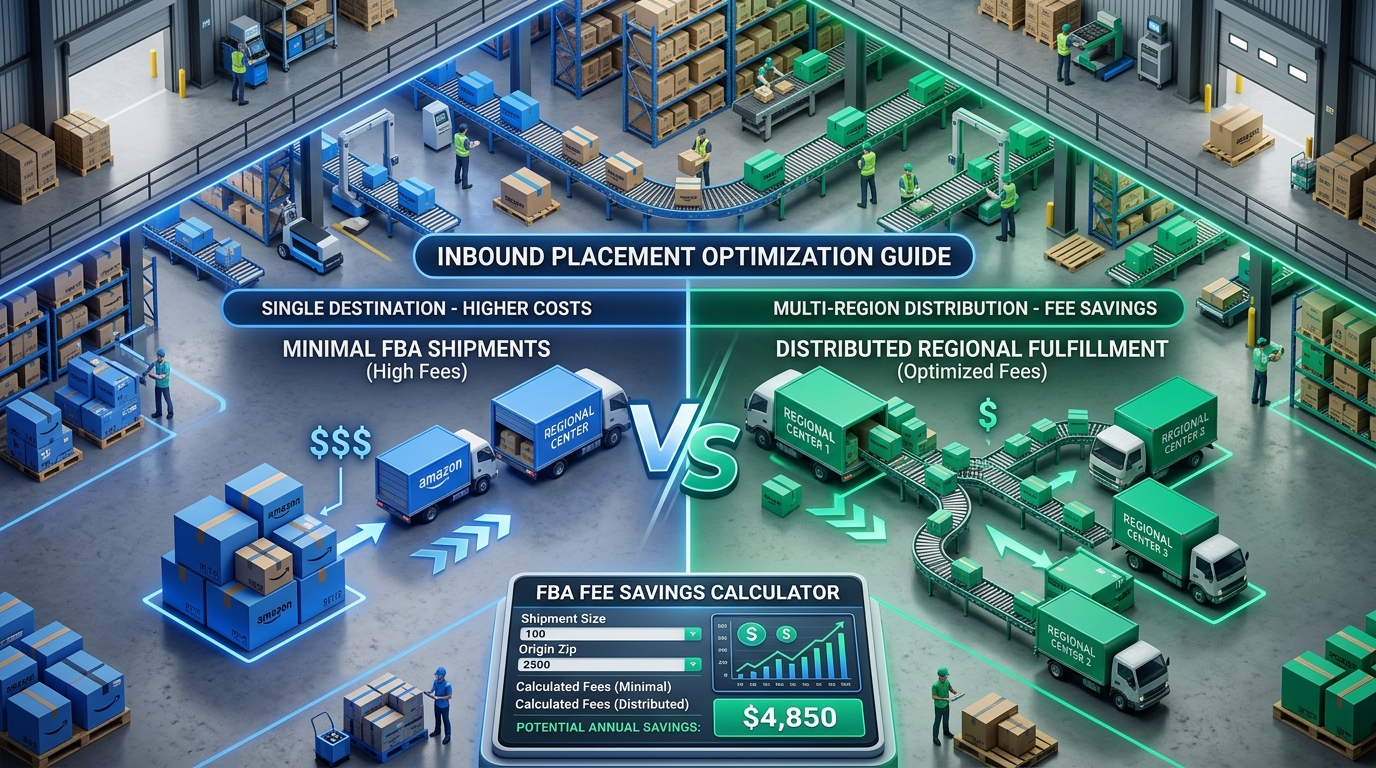
Since March 2024, sending inventory into FBA carries a decision with real money attached: the inbound placement service fee. Ship everything to one location and let Amazon distribute it across its network, and you pay up to ~$0.68 per standard-size unit for the privilege. Split your shipments across multiple inbound regions yourself, and the fee drops - potentially to zero.
The fee monetises a truth that was always there: spreading inventory across the country is expensive, and someone pays for it. What changed is that sellers now choose how to pay - in placement fees, in multi-destination freight complexity, or by restructuring inbound flow entirely through AWD.
Most sellers picked a default in week one and never re-ran the numbers. That is usually a mistake worth thousands a month. Here is how the options actually price out, the freight-vs-fee math, and the structural routes that sidestep the fee altogether.
The Three Placement Options and What They Cost
| Option | What you do | Placement fee |
|---|---|---|
| Minimal shipment splits | Send everything to 1 location (or 2 to 3 as offered); Amazon redistributes | Highest: ~$0.21 to $0.68/unit standard-size (weight-tiered); oversize higher, to ~$6 on heavy items |
| Partial splits | Ship to a middle number of destinations | Reduced per-unit fee |
| Amazon-optimized splits | Ship to 4+ destinations Amazon designates | No placement fee (standard-size) |
The fee is charged ~45 days after receiving, appears per unit in fee reports, and varies by size tier, weight, and the specific inbound locations offered (West-coast-heavy offers often carry different economics than Midwest spreads).
Key nuance: the destination sets Amazon offers you differ shipment by shipment - driven by your SKU mix and network state. The same catalog can see materially different fee quotes week to week, which is why a standing policy beats per-shipment guessing.
The Real Math: Fee vs Freight vs Labour
"No placement fee" is not "no cost" - optimized splits mean more shipments, more labels, potentially more LTL minimums. The comparison that matters, per shipment plan:
- Minimal splits cost = units × placement fee + single-destination freight
- Optimized splits cost = multi-destination freight + incremental 3PL/warehouse handling (extra picks, palletising, BOLs) + your team’s time
- For parcel-based (SPD) inbound, splitting is usually cheap - carriers price per box regardless of destination count, so optimized splits + zero fee wins
- For LTL/FTL freight, consolidation economics can favour one destination - a single full truckload’s rate advantage sometimes beats the placement fee, especially on heavy catalogs
- Bulky-but-light items flip fast toward splitting; heavy items flip toward consolidation - run the math at the size-tier level, not the account level
Worked example: 2,000 standard units at $0.35 average placement fee = $700 saved by optimized splits. If splitting turns one LTL into three at +$450 total freight and +$120 handling, splitting nets +$130 - thin. Same catalog via SPD parcels: splitting is nearly free, and the $700 is pure saving. The answer is a policy per inbound mode, reviewed quarterly.
Lowering the Fee Without Changing Strategy
- Case-pack discipline: clean, single-SKU case packs receive better destination offers than mixed cartons - Amazon can route uniform boxes deeper into the network
- Batch inbound by SKU family: larger, uniform shipments get more favourable split offers than dribbled mixed sends
- Check offers on different days: destination sets change with network state; when a quote looks unusually expensive, re-creating the shipment plan days later often prices better
- Ship-from location matters: a West-coast origin (near import ports) sees different offer economics than East-coast - worth knowing when choosing a 3PL location
- Watch the fee actuals: placement fees charged ~45 days later drift from estimates; reconcile monthly and dispute clear errors
The Structural Bypass: AWD and Upstream Flow
Amazon Warehousing & Distribution changes the question entirely: you send bulk inventory to AWD (one destination, low-cost bulk storage), and Amazon replenishes FBA from it continuously - with no inbound placement fees on that replenishment flow, no FBA capacity-limit consumption, and automatic protection against low-inventory fees on enrolled ASINs.
- Economics: AWD storage runs materially cheaper than FBA storage; you pay AWD processing/transport per unit instead of placement fees
- Best fit: steady-velocity, standard-size catalogs with predictable replenishment - the classic private-label profile
- Watch-outs: less granular control than a 3PL, and multi-channel needs (retail, DTC) still favour an independent 3PL buffer
- Many brands run the hybrid: AWD feeding FBA for marketplace flow, 3PL for everything else
For a catalog paying $3 to 8k/month in placement fees, the AWD evaluation is not optional analysis - it is a standing agenda item.
Turning This Into a Standing Policy
The end state is a one-page inbound policy: SPD parcels → optimized splits by default; LTL/FTL → run the fee-vs-freight comparison per plan above X units; heavy/oversize tiers → consolidate unless quoted fees exceed the freight delta; steady-velocity heroes → migrate to AWD replenishment; review the policy each time Amazon updates the fee table. Assign the shipment-creation checklist to whoever books freight, and audit one month of placement-fee actuals each quarter - the combination typically cuts placement spend 40 to 70% against a "always minimal splits because it is easy" baseline.
Frequently Asked Questions
When is the inbound placement fee charged?
Approximately 45 days after your shipment is received, as a per-unit charge in your fee reports. The estimate shows during shipment creation; reconcile actuals monthly because network-driven adjustments happen.
Is the optimized-split option always free?
For standard-size inventory meeting the split requirements (typically 4+ Amazon-designated destinations), yes - no placement fee. Oversize follows its own schedule. The real cost shifts to multi-destination freight and handling, which is why the comparison must include those lines.
Can I choose which fulfilment centres my inventory goes to?
No - Amazon designates the destinations in each option. You choose the split level (minimal/partial/optimized), and influence offers indirectly through case-pack quality, shipment size, SKU uniformity, and origin location.
Does AWD really avoid placement fees entirely?
Replenishment from AWD into FBA does not incur inbound placement fees, which is one of its headline economics alongside cheaper bulk storage and capacity-limit exemption. You pay AWD’s own storage and processing rates instead - for steady-velocity catalogs the net is usually favourable.
How do I know what I am currently paying in placement fees?
Transaction fee reports (and the fee-type breakdowns in payment reports) itemise "FBA inbound placement service fee" per unit. Sum a month by shipment and by SKU - most sellers who do this for the first time find the number larger than assumed, which is precisely the point of the exercise.