- AWD stores bulk cartons upstream and FBA stores sellable stock, so compare only the excess stock beyond your FBA cover.
- As of November 2026, Amazon lists AWD storage at $0.48 per cubic foot ($0.57 West Coast), plus $1.40 per box each way and $1.40 per cubic foot of transport.
- Break-even months per carton = (AWD handling minus placement fee avoided) divided by the monthly storage saving.
- In our illustration, a 24-unit carton takes 10.9 months to pay back at off-peak rates and 1.7 months at Q4 rates, with no placement fee avoided.
- From February 1, 2027, Amazon drops the FBA storage utilization surcharge and adopts a single age-based rate, which favors FBA for stock turning in under six months.
- Amazon's November 5, 2026 notice lists AWD among its 2027 updates without giving details, so confirm AWD rates in Seller Central before planning.
What is the difference between Amazon AWD and FBA storage?
FBA storage holds stock inside fulfillment centers, ready to ship to a customer. AWD holds bulk cartons upstream and feeds those fulfillment centers later. A unit in AWD cannot fill an order until it moves to FBA, so AWD works as a reserve tank behind FBA.
That framing settles most of the argument. You always need some FBA stock, because that is the stock customers can buy with Prime delivery. The only inventory worth comparing is the excess: the weeks of cover beyond what FBA needs to stay healthy. On a SKU with six weeks of total cover there may be no excess to move at all. On a SKU where you buy six months at a time because of ocean freight, most of the order is excess.
| Question | FBA storage | AWD |
|---|---|---|
| Can the unit ship to a customer today? | Yes | No, it has to transfer first |
| Is the storage rate seasonal? | Yes, Q4 is much higher | Amazon says no seasonal surcharge |
| What are you billed on? | Daily average cubic feet | Daily cubic feet, plus per-box processing and per-cubic-foot transport |
| Does it count against FBA capacity? | Yes | Amazon says it manages replenishment around your limits |
| Who is it available to? | All FBA sizes | Eligible products, checked when you book |
If AWD is new to you, our AWD setup walkthrough covers the Seller Central steps. This article stays on the money question. All figures here are for the US store, so check your own marketplace before applying them in the UK, EU or India.
What do AWD and FBA storage cost as of November 2026?
As of November 2026, Amazon lists AWD base storage at $0.48 per cubic foot per month in most regions and $0.57 on the West Coast. Add $1.40 per box inbound, $1.40 per box outbound and $1.40 per cubic foot of transport. FBA standard-size storage is reported at $0.78 off-peak and $2.40 in Q4.
| Cost line | AWD base rate | FBA, standard size |
|---|---|---|
| Storage, January to September | $0.48 per cu ft in East Coast, South East and South Central; $0.57 on the West Coast | $0.78 per cu ft, as reported by AMZ Prep and EcomCrew |
| Storage, October to December | Same rate, no peak charge listed | $2.40 per cu ft, same reports |
| Getting stock in | $1.40 per box ($1.05 in the West Coast Palletizable region) | Inbound placement fee, depending on the split you choose |
| Getting stock to the fulfillment center | $1.40 per box outbound plus $1.40 per cu ft | None, it is already there |
| Aged stock | No aged charge listed | Surcharge from 181 days until January 31, 2027 |
The AWD column comes straight from Amazon's AWD program page. Two discount tiers sit under the base rate. Smart storage cuts the storage line by 10%, and Amazon managed cuts it by 20% while dropping transport to $1.26. The $1.05 inbound rate is a promotion: the page's footnote ties a $0.35 discount to eligible shipments received through December 31, 2026, so do not assume it continues.
Amazon's FBA storage table sits behind a Seller Central login, so the FBA column is secondhand. Open the current rate in your own account before you commit a purchase order to either route.
Which published AWD and FBA figures conflict?
Four numbers disagree across the sources we read: the per-box AWD fee, AWD peak charges, 2025 storage in non-West regions, and the FBA off-peak storage rate. Amazon's own AWD page settles the first two. The other two stay open, and the FBA rate changes your break-even by a couple of months.
- Per-box fee. NovaData describes a new $0.05 box fee, while Amazon lists $1.40 per box each way. eStore Factory shows the move from $1.35 to $1.40, so the nickel looks like the size of the increase. Budget $2.80 for a box's round trip.
- Peak charges. NovaData says AWD peak surcharges run October 15 to January 14 and gives no amounts. Amazon's page says there are no extra holiday costs. We would go with Amazon and check your own invoices from last Q4.
- 2025 non-West storage. eStore Factory says it was $0.43 and rose to $0.48. NovaData and AMZ Prep say it stayed at $0.48. The current rate is the same either way, so this only matters if you are comparing against last year's bills.
- FBA off-peak storage. AMZ Prep and EcomCrew report $0.78. NovaData reports $0.87 from July 1, 2026. We use $0.78 below and show what $0.87 does to the answer.
The transport increase has no real dispute. Secondary sources agree the old rate was $1.15 per cubic foot and that $1.40 began on January 15, 2026. Amazon's page confirms the $1.40. Amazon's page does not state the old rate or the date itself.
Does the 2027 Amazon announcement change AWD or FBA storage?
Yes for FBA storage, and possibly for AWD. Amazon's November 5, 2026 notice removes the storage utilization surcharge on February 1, 2027 and folds the aged surcharge into one age-based storage rate. The notice lists AWD among topics with updates, but its text gives no AWD details or new rates. Our 2027 FBA fee guide lists the full set of changes.
Amazon says the storage redesign means "flat or lower fees for inventory that turns in under six months" and higher fees for aged stock. We read that notice as reposted on the Sellers Ask Sellers forum, since the original sits behind a login. As of November 6, we have not seen the new per-cubic-foot rates or any 2027 AWD price list, so nothing in this article is a 2027 rate.
We can only give the direction until those rates appear. Stock that turns inside six months gets a smaller reason to leave FBA, because its FBA cost holds or falls while AWD's handling fees stay in the math. Anyone who used AWD mainly to dodge the utilization surcharge should rerun the numbers in February. Stock older than six months moves the other way, since FBA gets more expensive for it, as long as the AWD update does not bring something similar.
The low-inventory-level fee also changes on February 1. The test becomes under 28 days of supply, using actual shipments across the four weeks on each side of the assessment date. Amazon expects that to cut charges caused by demand spikes and by seasonal or discontinued products. Fewer charges means the AWD waiver, covered below, is worth less than it was.
Open the 2027 US Referral and Fulfillment by Amazon fees page in Seller Central and read the AWD section, then the Fee Change Comparison dashboard in Profit Analytics. Replace the rates in the formula below with what you find there.
How do you calculate the AWD vs FBA break-even for one SKU?
Divide AWD's handling cost, minus any placement fee it saves you, by the monthly storage saving per carton. The result is how many months a carton must sit upstream before AWD pays for itself. Work it per carton, because box fees are charged per box and storage per cubic foot.
- Handling (H): inbound box fee + outbound box fee + (transport rate x carton cubic feet).
- Placement avoided (P): the per-unit placement fee you would otherwise pay x units per carton. Use your real Send to Amazon quote.
- Monthly gap (G): (FBA storage rate minus AWD storage rate) x carton cubic feet.
- Break-even months = (H minus P) divided by G. Zero or below means AWD is ahead from the first day.
The table is an illustration using the rates above, non-West AWD at base rate, and no placement fee avoided. It is one product of 0.0625 cubic feet packed three ways, so only the carton changes.
| Carton | Handling per carton | Handling per unit | Months to break even, Jan to Sep rates | Months, Q4 rates |
|---|---|---|---|---|
| 0.75 cu ft, 12 units | $3.85 | $0.32 | 17.1 | 2.7 |
| 1.5 cu ft, 24 units | $4.90 | $0.20 | 10.9 | 1.7 |
| 3.0 cu ft, 48 units | $7.00 | $0.15 | 7.8 | 1.2 |
On storage savings alone, between January and September, AWD takes most of a year to earn back its handling. Q4 shortens that to weeks, because the gap jumps from $0.30 to $1.92 per cubic foot.
Placement changes the off-peak result fast. Take the 24-unit carton. Avoiding a $0.10 per unit placement fee cuts break-even from 10.9 months to 5.6. Once the fee passes about $0.20 per unit ($4.90 / 24), AWD wins before storage is even counted.
Two sensitivity checks on that same carton. At NovaData's $0.87 FBA rate, the off-peak figure drops from 10.9 to 8.4 months. On the West Coast at $0.57, it stretches to 15.6 months off-peak and 1.8 in Q4, so West Coast AWD hurts most on long off-peak holds.
What does the math look like on a real purchase order?
In this illustration, a 1,440-unit order priced August through January costs $78.10 more through AWD before placement fees and $209.90 less once a $0.30 per unit placement fee is avoided. The SKU, the fee quote and the timing are invented to show the method, so run your own.
The SKU sells 240 units a month, or 10 of the 24-unit cartons above. You land 60 cartons on August 1. Plan A sends all 60 to FBA. Plan B sends 20 to FBA and 40 to non-West AWD, with 10 cartons transferring at the end of each month. Storage uses average cartons held per month, and rates are the 2026 figures through January 31, 2027. We ignored freight differences, transfer delays and any utilization surcharge.
| Cost line | Plan A: all FBA | Plan B: FBA plus AWD |
|---|---|---|
| FBA storage | $392.85 | $202.95 |
| AWD storage (150 cu ft months at $0.48) | $0 | $72.00 |
| AWD inbound and outbound (40 cartons x $2.80) | $0 | $112.00 |
| AWD transport (60 cu ft x $1.40) | $0 | $84.00 |
| Total before placement | $392.85 | $470.95 |
| Placement at $0.30 per unit (1,440 vs 480 units) | $432.00 | $144.00 |
| Total | $824.85 | $614.95 |
Plan B comes out $209.90 ahead, entirely because of the placement fee. Without it, Plan A wins by $78.10. Divide that $78.10 by the 960 units moved through AWD and you get the number to remember for this SKU: AWD pays if you would otherwise pay more than about $0.08 per unit in placement.
Shift the same order to six months at off-peak rates and the storage saving shrinks. Plan A costs $210.60 before placement and Plan B costs $361.60, a $151.00 gap, which puts the placement threshold near $0.16 per unit. A seller who can use Amazon-optimized splits at no placement fee, without much extra freight, should keep that off-peak order in FBA.
Run the result through our FBA profit calculator afterward. A saving of about $0.15 per unit (as in Plan B here) can be a large share of the margin on a low-priced item and barely visible on an expensive one.
How do inbound placement and prep rules change the comparison?
Placement often decides the result, since Amazon includes FBA inbound placement in AWD's price and bills nothing extra for it. Prep decides less, but it removes a myth: since January 1, 2026, Amazon no longer prepares or labels US FBA units, including stock arriving from AWD, so AWD saves you no prep work.
The placement figure to use is the lower of two costs: the fee on a minimal split, or the extra freight and handling of splitting the shipment to get a lower fee. AMZ Prep, in its own estimate of 2026 rates, puts standard-size minimal-split fees at about $0.14 to $1.90 per unit depending on weight and region. That range is why one catalog can land on both sides of the $0.16 off-peak threshold from our illustration. Our inbound placement guide walks through comparing fee against freight.
On prep, Amazon's seller forum notice names AWD among the routes covered. Units need to be ready for FBA before they enter AWD, because fixing a label problem after they are upstream is awkward and slow. MerchantSpring and SupplyKick both say products that need special prep are generally a poor fit or not accepted. Our prep and labeling guide has the requirements.
Eligibility has also narrowed, according to AMZ Prep, which reports that since July 31, 2026 AWD only takes sortable units, meaning below 20 pounds and below 18 x 14 x 8 inches. We did not find this on Amazon's public AWD page, which says only that eligibility is confirmed when you book. Test it by building a shipment plan before you book freight, particularly on anything near large standard limits.
How do auto-replenishment and the low-inventory fee affect the decision?
Auto-replenishment can add value by waiving the low-inventory-level fee, and it can cost you by moving the wrong quantity at the wrong time. Treat the waiver as a bonus to verify, and count it only if your SKU actually pays that fee today. Check your transaction reports, since many SKUs never trigger it.
An Amazon staff forum post says products auto-replenished by AWD are eligible for a waiver. That post is about three years old. AMZ Prep says the exemption needs 70% or more of replenishment to come through AWD, a condition we could not confirm in Amazon's wording, and the November 2026 notice does not say whether the waiver carries past February 1. Our low-inventory fee guide covers the current rules.
For scale, AMZ Prep's estimate of the lowest 2026 rate at 21 to 27 days of supply is $0.32 per unit. On our 240-unit SKU, a month in that band would cost $76.80. That is about the same as the $78.10 Plan A advantage above, so on a chronically thin SKU the waiver alone could flip the answer.
The operational risk runs the other way. In a MerchantSpring interview, Ephraim Ausch of Tactical Logistic Solutions, whose firm offers fulfillment services of its own, says auto-replenishment reads the last 30 days of sales. After a spike, it can overstock FBA at the higher storage rate. Amazon describes the feature only as a proprietary model that watches inventory levels.
Timing is unsettled too. SupplyKick reports sellers seeing transfers take several days to a week, while Ausch describes one to three weeks, slower before peaks. Amazon's page gives no figure. Measure your own lag on a test shipment and set the FBA floor from that, using the lead-time method in our inventory management guide.
AWD storage and transport are billed on cubic feet, so a mismeasured carton overcharges you on every line. Amazon's AWD service terms, dated January 14, 2026, allow reimbursement for fees charged on inaccurate box dimensions if you file within 90 days of the charge.
Which SKUs should use AWD and which should stay in FBA?
Use AWD for dense, eligible SKUs that hold several months of excess stock, especially through Q4 or when your placement quote is high. Keep FBA for fast turners with little excess, for cartons with few units, and for anything you can ship on optimized splits cheaply. The answer can differ between two SKUs in one shipment.
- Lean toward AWD when the carton holds many units, you buy in long ocean cycles, your placement quote is above your threshold, or stock would otherwise sit through October to December.
- Lean toward FBA when total cover is under about three months, the carton holds only a few units, or the SKU spikes unpredictably and a slow transfer would cost you the sale.
- Consider a 3PL when stock will sit a long time. Ausch's estimate, from his firm's analysis of more than 500 brands, is that a 3PL usually beats AWD after about 2.5 to 3 months of waiting. His firm offers fulfillment services, so get your own quotes.
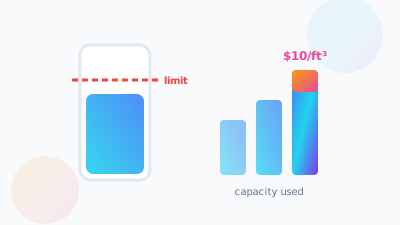
Capacity can override all of this. If you are near your limit, the alternative to AWD may be a $10 per cubic foot overage charge or a smaller order, as our capacity limit guide explains. Amazon says it manages AWD replenishment so that capacity is less of your concern, which can tip a capacity-constrained account toward AWD even when the storage math is close.
Note the tension between Ausch's three-month warning and our off-peak table, which needs far longer than three months for AWD to pay on storage alone. Both can be true: his comparison is against a 3PL, ours is against FBA. The practical reading is that long off-peak holds are where you should get a 3PL quote before choosing between Amazon's two options.
What mistakes make AWD cost more than it should?
The most expensive mistake is comparing storage rates alone, because $0.48 against $0.78 ignores about $2.80 per box of processing and $1.40 per cubic foot of transport. Close behind are sending too much stock upstream and shipping half-empty cartons, since box fees punish both.
- Moving your whole FBA position upstream. Stock that would sell inside your normal FBA cover pays handling and saves almost nothing.
- Shipping underfilled cartons. Box fees spread over more units get cheaper, and our table shows handling falling from $0.32 to $0.15 per unit on the same product. Ausch reports brands shipping four units in a box that could hold eight or ten. Stay under Amazon's 50-pound carton limit.
- Using one decision for a whole catalog. A single account-level average hides SKUs that lose money in AWD behind those that gain.
- Counting a low-inventory waiver you were never going to need. If the SKU has not paid the fee, it adds nothing to the case.
- Reusing a model built for 2026 after February 1, 2027. The FBA surcharges in it will be gone, and the AWD section of Amazon's 2027 summary may change the other side too.
Start with one or two SKUs on a single purchase order and compare invoiced fees against the formula. Rerun it in February once the new FBA rates are live in your account, and again before you commit to Q4 2027 stock.
Sources and data notes
Facts in this article were checked against the sources below on November 6, 2026. Amazon and agencies change programs and prices often, so confirm details before you act.
- Amazon: Amazon Warehousing and Distribution program page
- Amazon Supply Chain Services: AWD service terms, dated January 14, 2026
- Amazon: Fulfillment by Amazon program page
- Amazon Seller Forums: FBA prep services notice
- Amazon Seller Forums: Low-inventory-level fee further explained
- Sellers Ask Sellers: 2027 Amazon FBA rate increases (repost of Amazon's notice)
- EcomCrew: Amazon's 2027 fee math
- MerchantSpring: AWD looks cheaper than your 3PL
- AMZ Prep: Amazon FBA fees rate card
- AMZ Prep: AWD now accepts sortable items only
- AMZ Prep: Low inventory level fee explained
- NovaData: AWD fee increases 2026
- NovaData: FBA storage fee overhaul
- eStore Factory: 2026 AWD fee increases
- SupplyKick: Amazon Warehousing and Distribution guide
Frequently Asked Questions
Is Amazon AWD cheaper than FBA storage?
On the monthly rate, yes: Amazon lists AWD at $0.48 per cubic foot in most regions, against a reported $0.78 for FBA standard-size off-peak. Once you add $2.80 per box of processing and $1.40 per cubic foot of transport, AWD only wins on stock held for months, through Q4, or when it replaces a placement fee.
How much does AWD cost per cubic foot in 2026?
As of November 2026, Amazon lists base storage at $0.48 per cubic foot per month across the East and South regions and $0.57 on the West Coast. Smart storage is 10% cheaper and Amazon managed is 20% cheaper. Transport is $1.40 per cubic foot, or $1.26 at the managed rate.
Do you pay inbound placement fees with AWD?
Amazon includes FBA inbound placement in AWD's price, so that stock carries no separate placement charge. In our illustration this was the largest single benefit. It only counts if you would otherwise pay the fee, so compare against your real Send to Amazon quote and the cost of shipping optimized splits instead.
Does AWD get rid of the low-inventory-level fee?
An Amazon staff forum post says products auto-replenished by AWD are eligible for a waiver, and AMZ Prep says 70% or more of replenishment must come through AWD. Amazon's November 2026 notice changes the fee test from February 1, 2027 without mentioning the waiver, so confirm the rule in Seller Central first.
Will AWD fees change in 2027?
Possibly. Amazon's November 5, 2026 notice lists AWD among topics with additional updates in its full 2027 fee summary, but the notice text gives no AWD details and we did not find a 2027 AWD price list as of November 6. Read that summary in Seller Central before using 2026 rates for next year.
Does Amazon prep or label units sent to AWD?
No. Amazon's notice says prep and item labeling for US FBA shipments ended on January 1, 2026, and that this covers inventory coming from AWD. Units should be fully prepped and labeled to FBA standards before they enter AWD, since Amazon will not do that work at any point on the way to a fulfillment center.
How long does AWD take to replenish FBA?
Amazon's AWD page does not publish a transfer time. SupplyKick reports sellers seeing several days to a week, while logistics operator Ephraim Ausch, in a MerchantSpring interview, describes one to three weeks and slower receiving before peaks. Measure your own lag on a test shipment, then set your FBA stock floor from that number.
Should I use AWD or a 3PL?
It depends on how long stock will sit. Ephraim Ausch of Tactical Logistic Solutions estimates a 3PL usually beats AWD after about 2.5 to 3 months of waiting, though his firm offers fulfillment services. Get a real 3PL quote and run it through the same per-carton formula used for AWD and FBA.
Want a second opinion on your AWD split?
Send us your SKU list and we will run the per-carton math with you. SellerVine plans are month to month with a flat fee, and our free FBA profit calculator is there if you would like to start on your own.
Get a free account audit