Why "Just Add Negatives" Isn't a Strategy
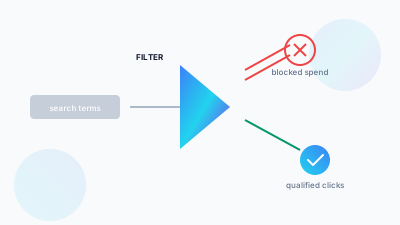
Negative keywords get treated as janitorial work - something you do once a month when you remember, to tidy up a search term report that's gotten embarrassing. That framing is backwards. Negative keyword management isn't cleanup after the fact; it's a structural control on where your budget is allowed to flow in the first place. Accounts with disciplined negative keyword hygiene don't just spend less on junk clicks - they spend meaningfully more of their budget on the search terms that were already converting, because every dollar not wasted on an irrelevant click is a dollar available to bid more aggressively on a proven one.
In accounts we audit that have never had a structured negative keyword process, it's common to find a fifth or more of total ad spend going to search terms that never converted and, on inspection, were never going to - wrong intent, wrong product category, or a modifier ("free," "used," "diy," "replacement parts") that signals a shopper who was never going to buy your exact product.
The Two Negative Match Types (And the One That Doesn't Exist)
Amazon supports exactly two negative match types: negative exact and negative phrase. There is no negative broad match - a detail that trips up sellers coming from other ad platforms where broad negatives exist. Understanding what each type actually blocks is the difference between a negative list that protects spend and one that quietly suppresses converting traffic.
Negative Exact: Precision Without Collateral Damage
Negative exact blocks only the exact search term you specify, character for character. If you add "phone case" as a negative exact, it blocks searches that are precisely "phone case" - not "phone case blue" and not "iphone phone case." This is the safest negative type because its blast radius is exactly one search term. Use it for search terms you've confirmed convert poorly, and use it as part of the tier-flow discipline covered in our campaign structure guide: when a term proves profitable in a broad or phrase campaign, add it as an exact match in a dedicated conversion campaign, and simultaneously negative-exact it out of the broad campaign, so your own campaigns stop bidding against each other for the same term.
Negative Phrase: Powerful, and Easy to Overuse
Negative phrase blocks any search containing that phrase, regardless of what other words surround it. Adding "cheap" as a negative phrase blocks "cheap coffee maker," "coffee maker cheap," and every other variation containing that word, in one move. This is enormously efficient for blocking entire categories of irrelevant intent without listing every possible variation individually - but the same broad reach makes it easy to accidentally suppress a converting long-tail search you never noticed was hiding inside a broader phrase you blocked for an unrelated reason.
A supplement brand had negative-phrased "kids" to avoid pediatric-intent traffic on an adult product. That single negative was also silently blocking "kids of all ages" - a phrase appearing in a converting long-tail search for a family-oriented gift bundle. The fix isn't to avoid negative phrase; it's to review what you've blocked on a schedule, not just what you've added.
Campaign-Level vs. Account-Level Negative Lists
Negatives can be applied at the individual campaign level or, for terms that should never generate traffic anywhere in your account, maintained as a shared negative list applied automatically across every campaign, including new ones as you launch them. Build the account-level list for things that are permanently irrelevant regardless of campaign - competitor brand names you're not deliberately targeting, product categories you don't sell, and obvious mismatches. Reserve campaign-level negatives for the tier-flow discipline and for terms that are relevant in one campaign's context but not another's.
Skipping the account-level list is how sellers end up manually re-adding the same handful of obvious negatives to every new campaign they launch, forever, instead of setting the boundary once.
The Weekly Harvesting Workflow
Negative keyword management works best as a standing weekly habit, not a periodic cleanup project. Pull the search term report weekly and apply a simple threshold rule: flag any search term with a meaningful number of clicks and zero conversions, where spend has already exceeded roughly your target cost-per-acquisition for that product without a single sale. Terms that clear that threshold get negative-exacted immediately. Terms showing a pattern of irrelevant intent (wrong product type, wrong price tier, obviously mismatched modifier) get evaluated for negative phrase treatment.
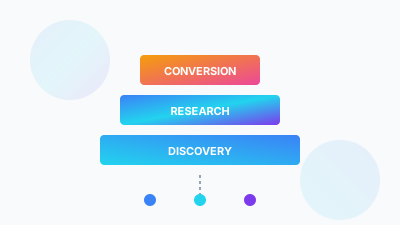
This is also where you harvest in the other direction: search terms performing well in a discovery or research campaign get promoted into a dedicated exact-match conversion campaign, with the corresponding negative exact applied back in the source campaign, closing the loop described above.
The Over-Blocking Trap
The most common negative keyword mistake isn't under-management, it's over-management by someone anxious about wasted spend who starts negative-phrasing broadly on thin data. A search term with two clicks and no conversions is not evidence of anything yet - it's noise. Give terms a fair sample size before judging them; a reasonable rule of thumb is waiting for a click volume that would statistically justify a conclusion for your specific price point and category, not an arbitrary universal number. Audit your negative keyword lists on a quarterly cadence specifically looking for phrase negatives that might be catching more than intended, not just adding new ones.
Building Your Starter Negative List
For most physical product categories, a defensible starting account-level negative list includes: intent-mismatch modifiers ("free," "cheap," "used," "refurbished," "wholesale," "bulk" - unless any of these genuinely describe your offer), DIY/instructional intent if you sell a finished product rather than parts or materials, job/career search terms that occasionally leak in for brand-name-adjacent queries, and any competitor brand names you have deliberately decided not to target. Beyond that starter set, the real list should be built from your own search term data, not copied wholesale from a generic template - what's irrelevant for one category is core converting traffic for another.
What Good Negative Keyword Hygiene Actually Saves You
The value isn't just the wasted spend you stop losing - it's what that reclaimed budget lets you do instead. Every dollar not spent chasing an irrelevant search term is a dollar you can put behind a bid increase on a term you already know converts, which compounds: tighter negative hygiene lowers blended ACoS not by cutting spend, but by reallocating the same spend toward proven performance. That's the actual argument for treating this as a weekly discipline instead of a quarterly chore.
Frequently Asked Questions
No, Amazon supports exactly two negative match types: negative exact and negative phrase. This trips up sellers coming from other ad platforms where broad negatives exist. Negative exact blocks only that one search term, character for character. Negative phrase blocks any search containing the phrase, wherever it sits in the query.
Weekly, as a standing habit rather than a monthly tidy-up. Pull the search term report each week and negative-exact any term with meaningful clicks, zero conversions, and spend already past your target cost per acquisition for that product. Terms showing a pattern of irrelevant intent get evaluated for negative phrase treatment instead.
It can, and over-blocking on thin data is the more common mistake. One audit found a supplement brand had negative-phrased 'kids' to avoid pediatric traffic, which silently blocked 'kids of all ages' inside a converting long-tail search. Two clicks with no conversions is noise, not evidence. Audit what you've blocked quarterly, not just what you're adding.
Put permanently irrelevant terms on a shared account-level list so they apply automatically across every campaign, including ones you launch later. That covers competitor brands you aren't deliberately targeting, categories you don't sell, and obvious mismatches. Keep campaign-level negatives for tier-flow work and terms relevant in one campaign's context but not another's.