What Amazon DSP Actually Is (and Isn't)
Amazon DSP stands for Demand-Side Platform - a programmatic advertising system that buys display, video, and audio ad inventory both on Amazon's own properties and across thousands of third-party sites and apps. That's the technical definition. The practical one matters more: DSP is not "Sponsored Display with a bigger budget," and treating it that way is the single most common reason brands walk away from it disappointed.
Sponsored Products, Sponsored Brands, and Sponsored Display are all auction-based, keyword-or-product-targeted, and billed on a cost-per-click basis. DSP works on a completely different model: you target audiences rather than keywords, inventory is bought programmatically against real-time bid requests, and billing is typically CPM (cost per thousand impressions), not CPC. You're not bidding on a search term - you're bidding on the opportunity to show an ad to a specific person, wherever they happen to be browsing at that moment.
DSP vs. Sponsored Ads: Two Fundamentally Different Systems
Sponsored Ads live inside a single, well-defined moment: someone is actively searching or browsing on Amazon, and you're competing for their attention right then. DSP operates across the entire customer journey, including the parts that happen nowhere near a search bar - someone streaming a show on Fire TV, listening to the free tier of Amazon Music, or reading an article on a completely unrelated website that happens to run Amazon's ad exchange.
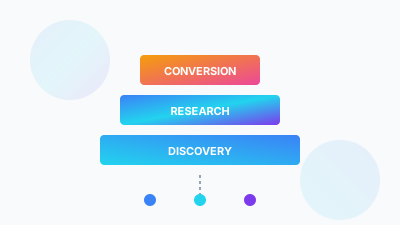
That distinction changes what each tool is good at. Sponsored Ads convert intent that already exists. DSP can build awareness before intent exists, and recapture it after someone has already shown interest and left without buying. Neither replaces the other - they sit at different points in the funnel, and the accounts that get the most value from DSP are the ones that already have Sponsored Products and Sponsored Brands doing the conversion-stage work well.
We regularly audit accounts where DSP was turned on with the same expectations as Sponsored Products - a target ACoS and a "let's see how it performs" mindset. DSP campaigns judged purely on last-click ROAS almost always look worse than Sponsored Products, because a meaningful share of DSP's value shows up as incremental lift in organic and branded search, not as direct DSP-attributed sales.
Self-Service vs. Managed-Service DSP
Amazon offers two paths into DSP. Self-service means you or your agency operates the console directly - building campaigns, setting audiences, managing creative, and adjusting bids in real time. Managed-service means Amazon's own team runs the account on your behalf, typically with meaningfully higher minimum spend commitments and less day-to-day control over targeting decisions.
Most mid-sized brands are better served by self-service DSP run through an agency partner. You get direct access to performance data, faster iteration on audience segments, and the ability to react to what's actually working instead of waiting on a quarterly review cycle. Managed-service makes more sense for enterprise brands running complex, multi-market programmatic strategies who want Amazon's team absorbing the operational load.
The Audiences DSP Gives You Access To
The targeting options are where DSP earns its complexity. Broadly, they fall into four categories:
Amazon shopping signal audiences: In-market segments (people actively shopping a category right now), lifestyle segments (broader interest-based groupings), and category-affinity audiences built from real purchase and browse behavior across Amazon - not modeled guesses, actual behavioral data.
Remarketing audiences: Shoppers who viewed your product detail page, or a competitor's, without purchasing. This is usually the highest-converting DSP audience type available, because you're re-engaging demonstrated purchase intent rather than trying to create it.
Lookalike audiences: Amazon builds a model of shoppers who resemble your existing purchasers, based on shared behavioral patterns. Useful for prospecting once you have enough purchase history to build a reliable seed audience.
First-party audiences: Custom lists you upload directly - your own customer emails, for instance - matched against Amazon's user base for targeting or exclusion.
Where Your Ads Actually Show Up
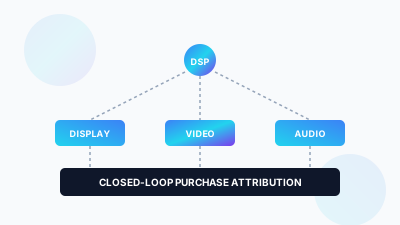
DSP inventory spans Amazon-owned properties (Amazon.com itself, IMDb, Twitch, Amazon Music's free tier, Fire TV's home screen) and Amazon's third-party publisher network, which reaches well beyond Amazon's own ecosystem through the Amazon Publisher Services exchange. Format-wise, that breaks into three lanes: standard display banners, video (including OTT/streaming placements on Fire TV and connected TV), and audio (pre-roll spots on Amazon Music's ad-supported tier).
Video and OTT placements in particular are worth understanding on their own terms - they're closer to traditional TV advertising in format and cost than anything else in Amazon's ad stack, and they're one of the only ways to buy connected-TV inventory with Amazon's purchase data behind the targeting.
The Attribution Advantage Nobody Talks About
Programmatic advertising everywhere else on the internet relies on modeled or probabilistic attribution - pixels, cookies, statistical inference about whether an ad exposure led to a sale. DSP doesn't have to guess. Because Amazon can see the actual purchase in its own systems, DSP attribution is closed-loop and deterministic: if someone saw your ad and bought the product on Amazon within the attribution window, that's a confirmed, not modeled, conversion.
This is DSP's real structural advantage over generic programmatic platforms, and it's worth stating plainly in any internal conversation about budget: you're not buying reach and hoping it correlates with sales. You're buying reach with the ability to measure, with certainty, whether it led to a transaction.
When DSP Is Worth It (and When It Isn't)
DSP earns its budget when at least one of these is true: you have meaningful traffic loss to competitor conquesting on your own detail pages and need a defensive retargeting layer; you're launching in a competitive category and need upper-funnel awareness before Sponsored Ads can convert efficiently; you have enough purchase history to build real lookalike audiences; or you're trying to reach customers off-Amazon entirely, which nothing else in Amazon's ad stack does.
DSP is premature for brand-new catalogs with no purchase history, accounts still working out basic Sponsored Products profitability, or budgets too small to reach the frequency needed for programmatic learning to stabilize - DSP campaigns typically need real budget runway before the algorithm has enough signal to optimize meaningfully.
Common DSP Mistakes We See in Audits
No frequency capping: Showing the same shopper the same ad 40 times a week doesn't build affinity, it builds fatigue. Cap frequency deliberately based on funnel stage - higher for remarketing, lower for prospecting.
Treating all creative as interchangeable: Static display banners built for Sponsored Display get reused for video and OTT placements, where the format expectations are completely different. Video needs to work with sound off in the first three seconds and tell a complete story in 15 to 30 seconds.
Judging performance too early: Programmatic algorithms need volume to optimize. Killing a campaign at day 10 because ROAS looks weak, before the algorithm has had a real learning window, throws away the investment already made in that learning.
Ignoring off-Amazon incrementality: Measuring DSP purely on Amazon-attributed sales misses the point of running it off-Amazon in the first place. If you can, run a holdout test - pause DSP for a defined market or audience segment and measure the change in branded search and direct traffic.
How to Measure DSP Correctly
Judge upper-funnel DSP campaigns (prospecting, lookalikes, OTT/video) on reach, frequency, and the trailing lift in branded search volume and new-to-brand purchase rate - not click-through ROAS. Judge remarketing campaigns on direct ROAS, since that audience already has established intent and should convert efficiently. Track new-to-brand metrics specifically; DSP's new-to-brand purchase rate is one of the clearest signals of whether the platform is actually expanding your customer base or just re-selling to people who already knew you.
Frequently Asked Questions
It's a different system. Sponsored ads are auction based, keyword or product targeted, and billed per click. DSP targets audiences, buys inventory programmatically against real time bid requests, and typically bills on CPM. You're bidding on the chance to show an ad to a specific person wherever they're browsing, not on a search term.
Last click ROAS is the wrong yardstick for most DSP campaigns. A meaningful share of DSP's value shows up as incremental lift in organic and branded search rather than DSP attributed sales. Judge prospecting, lookalike and video campaigns on reach, frequency, branded search lift and new to brand rate, and save direct ROAS for remarketing.
DSP is premature for brand new catalogs with no purchase history, accounts still working out basic Sponsored Products profitability, and budgets too small to reach the frequency programmatic learning needs. The accounts that get the most value already have Sponsored Products and Sponsored Brands handling the conversion stage work well.
Remarketing audiences, meaning shoppers who viewed your detail page or a competitor's without buying, are usually the highest converting type available, because you're re-engaging intent that already exists. Lookalikes and Amazon's in market and lifestyle segments are prospecting tools, useful once you have enough purchase history to build a reliable seed audience.