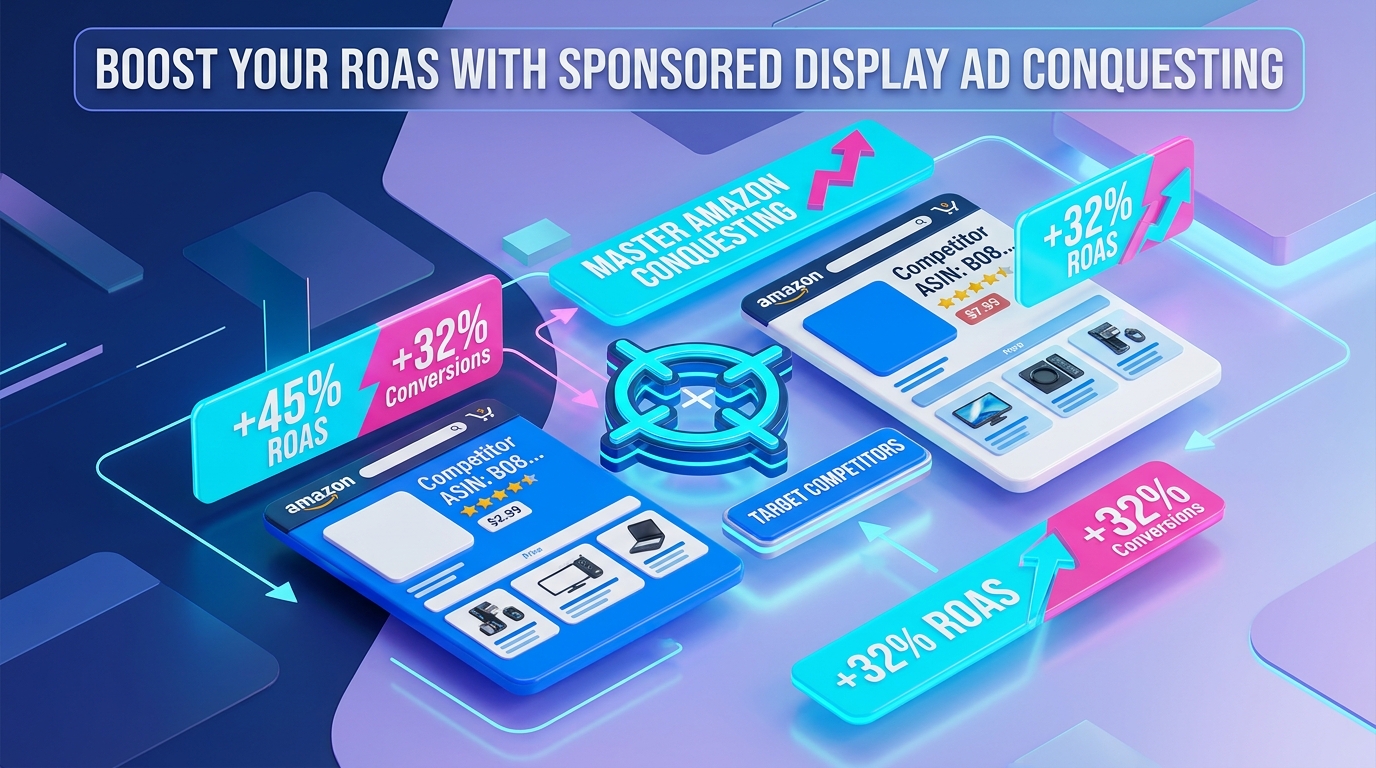
Every day, shoppers sit on your competitors’ product pages, comparing, hesitating, reading the one-star reviews. Sponsored Display conquesting is the discipline of being present at exactly that moment - your product, your offer, placed on their detail page, making the case for switching before the add-to-cart click happens.
It is also the most commonly wasted budget line in Sponsored Display, because most sellers run it as "target every competitor ASIN and hope". Effective conquesting is narrower and meaner: attack only where you win a head-to-head comparison, with creative built for the comparison shopper, measured on incremental share rather than vanity ROAS.
Here is the full system: how SD targeting actually works for conquesting, competitor selection from data, the creative that converts on hostile territory, and the defensive counterpart on your own pages.
How Sponsored Display Conquesting Actually Works
Two SD targeting families power conquesting:
- Contextual (product) targeting: your ad appears on the targeted ASIN’s detail page - the classic placement under the buy box or mid-page. This is the precise "raid their page" tool: you choose the ASINs, categories, or refinements (price range, star rating, brand).
- Audiences targeting: Amazon builds shopper pools - views remarketing (viewed your or similar products), purchases remarketing, and in-market/lifestyle audiences. For conquesting, "similar product views" audiences chase shoppers who browsed competitors, following them beyond the detail page across Amazon and off-site placements.
The two compound: contextual wins the on-page decision moment; audiences recapture the comparison shopper for days afterwards. Bidding supports optimise for conversions / reach / page visits - conquesting almost always wants conversion optimisation, cost-per-click can run higher than Sponsored Products for the same real estate, and that is fine when the target selection is right.
Picking Raidable Competitors From Data
Conquesting fails when you attack strongholds. It pays when you attack the weak flank. Build the target list from evidence:
| Signal | Where to find it | What it means |
|---|---|---|
| You already convert their shoppers | Search-term / advertised-product reports: competitor ASINs converting in your auto & category campaigns | The market has voted - scale what works |
| Rating gap | Their 3.9★ vs your 4.5★ | Comparison shoppers read stars first; a half-star gap is a wedge |
| Price/value wedge | You win on price, size, count, or bundle at similar quality | The on-page comparison favours you |
| Weak content | Their thin images/A+ vs your strong page | Shoppers bounce from weak pages - give them a landing spot |
| Stock/price instability | Their frequent OOS or price yo-yo | Their weakness windows are your cheapest wins |
| Review complaints you solve | Their 1 to 2★ themes match your strengths | Creative can speak directly to the pain |
Anti-pattern: conquesting the category king with more reviews, better price, and stronger content than you. You fund their page’s ad revenue and buy nothing. If you cannot name the reason a rational shopper switches, do not bid on the page.
Creative for Hostile Territory
On a competitor’s page, default auto-generated creative (your image + title) rarely beats inertia. Purpose-built SD creative does:
- Lead the differentiator, not the brand: the shopper is mid-comparison - headline the wedge ("2× the coverage", "No tools needed", "4.6★ from 8,000 buyers")
- Custom image over pack shot: lifestyle-plus-product creative measurably outperforms bare catalog images in SD placements
- Match the objection: if their reviews complain about durability, your creative says warranty/materials; if about sizing, yours says fit guarantee
- Test headlines quarterly: SD supports custom headline + image; run 2 to 3 variants per target cluster and let conversion decide
- Price display logic: show deal badges/coupons when you win on price; hide price emphasis when you win on quality
Measuring Conquesting Honestly
Conquesting ROAS reads worse than branded remarketing ROAS - and should, because it buys new-to-brand demand rather than harvesting existing intent. The honest scorecard:
- New-to-brand share: SD reports NTB metrics - conquesting campaigns should run high (60%+); low NTB means you are paying conquest CPCs for shoppers you already own
- Segment by target cluster: group targets (by competitor brand, by wedge type) into separate campaigns so winners/losers are visible and budget follows evidence
- Watch category share, not just campaign ROAS: sustained conquesting shows up in your share of the targeted niche; that is the actual objective
- Prune on a cadence: targets with clicks and no conversions over a meaningful window get cut - page-level fit either exists or it does not
- Expect halo: some conquest conversions land on organic/branded later; NTB customer value compounds through repeat purchase, which pure last-click ROAS never credits
The Defensive Counterpart: Your Own Pages
While you raid, you are being raided - open your hero ASIN’s page and count competitor ads on it. Defensive SD/SP placements on your own detail pages (targeting your own ASINs and complementary products) crowd rivals out of the comparison slots, cheaply - your own page is your highest-converting real estate. Standard defensive kit: SD product targeting on your own ASIN family, cross-sell targeting between complementary SKUs (raising basket value while occupying slots), and Sponsored Brands defence on your branded search terms. Sellers who conquest without defending usually discover they are net exporters of exactly the demand they are paying to import.
Frequently Asked Questions
What is the difference between SD conquesting and Sponsored Products ASIN targeting?
SP product targeting also places you on competitor pages (in search-style ad slots); SD adds distinct on-page placements, off-Amazon reach, audience remarketing, and custom creative (headline + lifestyle image). Mature setups run both: SP ASIN targeting for volume, SD for placement coverage, creative control, and re-engagement.
Why is my conquesting ACOS so much higher than my other campaigns?
Because it is buying new-to-brand demand at the competitor’s moment of decision - the hardest, most valuable conversion. Judge it on NTB share, incremental category share, and customer lifetime value, with an ACOS ceiling set from contribution margin, not from what branded remarketing achieves.
How many competitor ASINs should I target?
Start narrow: 10 to 25 hand-picked ASINs where you have a provable wedge, clustered into campaigns by competitor or wedge type. Broad category targeting has its place for discovery, but conquesting budgets concentrate on the pages you can actually win.
Do I need Brand Registry for Sponsored Display?
Yes - SD is available to brand-registered sellers (and vendors). Registry also unlocks the custom creative options (headlines, lifestyle imagery) that make conquesting creative competitive on hostile pages.
Should small brands conquest the market leader?
Only at the leader’s weak points: specific ASINs with rating gaps, stockout windows, or unserved sub-needs (size, material, use-case). Head-on conquesting of a stronger page wastes budget - flank, don’t charge.