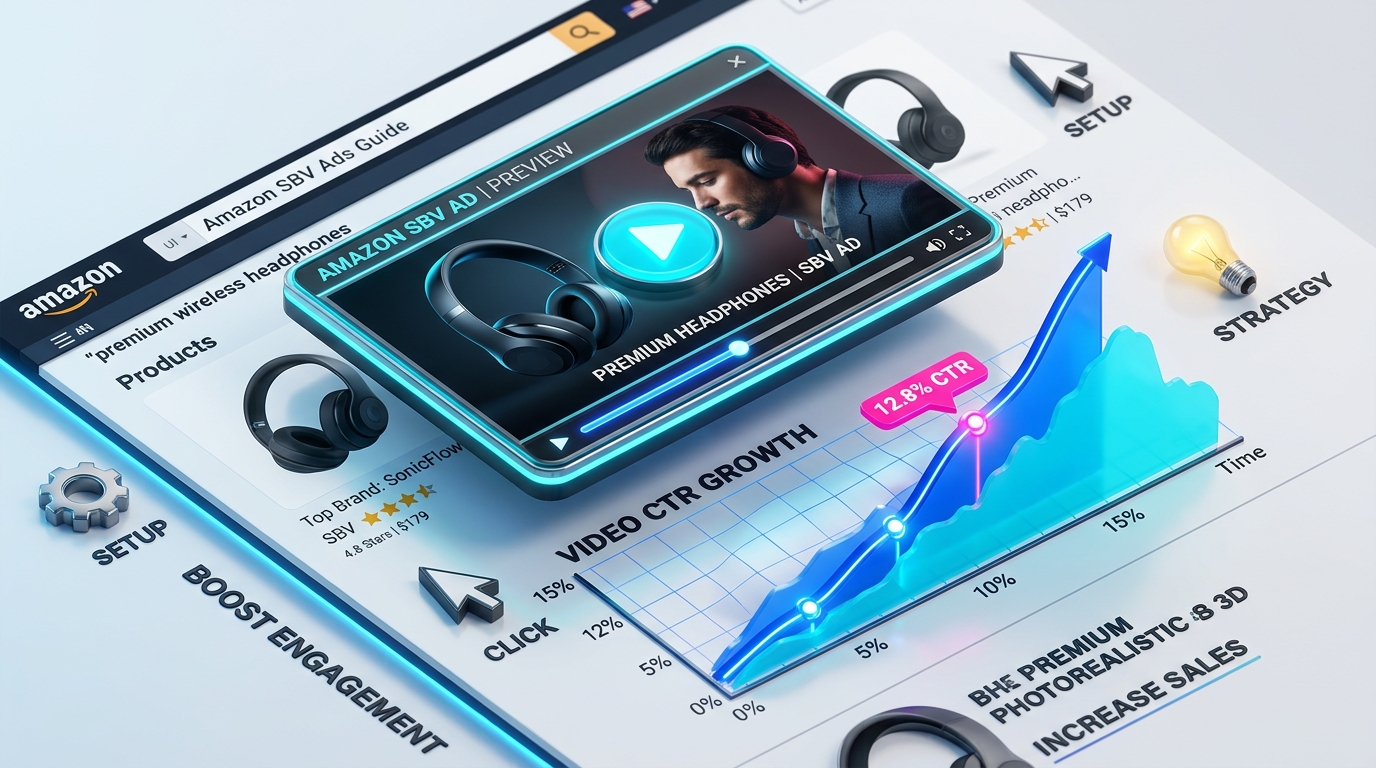
Scroll any competitive Amazon search and one ad format visibly interrupts the scan: the auto-playing video card spanning the results. That is Sponsored Brands Video - the highest-attention placement in Amazon search, and one that frequently clears at CPCs comparable to or below top-of-search text ads, because the constraint is not auction budget but creative supply: most brands simply do not have video that works.
That asymmetry is the opportunity. Sellers with even modestly competent product video routinely see SBV deliver their best blended CTR-to-conversion economics in Sponsored Brands - while sellers who upload a repurposed TV spot or a logo animation watch it burn budget, because SBV has viewing conditions (muted, small, 3-second judgment) that punish generic video.
Here is the format in practice: specs and slots, the creative grammar that converts in a muted 30-second loop, keyword strategy specific to video, and the measurement/scaling loop.
The Format: Slots, Specs, and What Auto-Play Changes
- Placement: in desktop and mobile search results (mid-results card), auto-playing muted on scroll-into-view, looping; click-through lands on the product page or Store
- Core specs: 6 to 45 seconds (sweet spot 15 to 30), 1920×1080 or higher, under 500MB; captions/text overlays effectively mandatory because audio starts muted
- Targeting: keyword and product targeting like Sponsored Brands; one video per campaign creative, linked to one or more advertised ASINs
- The auto-play contract: you get ~1 to 3 seconds of unearned attention as the card scrolls in - everything about the creative is built around converting that accident into a deliberate watch
Creative Grammar: What Converts in Muted, Small, and Fast
The first 3 seconds decide everything
Open on the product in use, mid-action - not a logo, not a title card, not an establishing shot. The scroller must recognise what it is and why it matters before their thumb moves.
Design for silence
Assume 95% of views are muted: benefit text overlays timed to the visuals, readable at mobile card size (big type, short phrases, high contrast). If the video makes sense with sound off, sound on becomes a bonus.
Loop-aware structure
- 15 to 30s beats maximum length: show the product solving the problem, 2 to 3 benefit beats, end frame with product + one-line value prop
- The loop means your "ending" is also a second beginning - avoid long fade-outs; land on a frame that re-hooks
- One idea per video: SBV is not the place for the five-feature tour; make the demo of the single strongest differentiator
Production reality
Phone-shot product demos with clean lighting and sharp text overlays reliably outperform expensive brand films in this slot. Budget for iteration (three cheap variants beat one polished one), and refresh creative before fatigue: CTR decay after weeks at scale is the tell.
Keyword Strategy Specific to Video
- Start where you already convert: seed SBV with keywords proven in Sponsored Products - video changes the slot, not the intent
- Category and problem terms outperform expectations: video demonstrates; mid-funnel "how do I…" and category browse terms often convert better in SBV than in text ads
- Branded defence: an SBV card on your own brand terms is powerful (and cheap) real estate against conquesting rivals
- Match-type discipline: phrase/exact cores with modest broad discovery; SBV CPCs punish sloppy broad harvesting
- Competitor terms with a wedge: video is the best format for "watch why shoppers switch" - but only where a genuine comparison advantage exists
Measurement and the Scaling Loop
- Judge the funnel in stages: impressions → view metrics (video first-quartile/complete views) → CTR → conversion; a strong-view/weak-CTR video has an end-frame or overlay problem, a strong-CTR/weak-conversion one has a landing-page mismatch
- Compare against your own SB/SP baselines per keyword cluster - SBV commonly wins CTR by 2 to 4× on the same terms; conversion parity at higher CTR is a win
- New-to-brand share: SBV skews NTB-heavy on category terms - value it accordingly
- Scale sequence: prove on exact winners → expand budgets on efficient clusters → add adjacent keyword themes → refresh creative on fatigue signals → test Store-landing vs product-page landing per cluster
- Creative A/B: run hook variants (first-3-second alternatives) against identical targeting; the hook test is the highest-leverage experiment in the format
The Five Ways SBV Budgets Die
- Opening with logos/brand anthem - the scroll moves on before the product appears
- Sound-dependent creative - dialogue or voiceover carrying meaning that muted viewers never receive
- Illegible overlays at card size - designed on a 27″ monitor, viewed on a 6″ phone
- One video across all intent levels - the branded-defence video and the category-education video are different jobs
- Set-and-forget - no creative refresh, no hook testing, no per-cluster budget reallocation; SBV rewards iteration more than any other Amazon ad format
Frequently Asked Questions
What are the basic requirements to run Sponsored Brands Video?
Brand Registry enrolment, a video meeting spec (6 to 45s, 1080p+, size limits), and standard Sponsored Brands campaign access. The practical requirement is creative that works muted at small size - the format is open to everyone but rewards prepared brands.
How long should my SBV video be?
15 to 30 seconds is the working sweet spot: long enough for a hook plus two benefit beats and a strong end frame, short enough to hold completion rates. The 45-second maximum is almost never optimal in this slot.
Why is my SBV getting views but a low CTR?
Usually an end-frame/overlay problem: viewers watch the loop but are given no reason or moment to click. Strengthen the persistent value-prop overlay, land the loop on a re-hooking product frame, and check that the advertised ASIN’s price/rating (shown on the card) supports the click.
Should the video click through to my product page or my Store?
Test per keyword cluster: product-page landing usually wins for high-intent and branded terms (shortest path to buy); Store landing can win for category/education terms where range and brand context help. Default to product page until data argues otherwise.
Can I reuse my SBV video elsewhere?
Yes - the same muted-first, hook-led asset typically ports well to Sponsored Display video, product-page video slots, and social cutdowns. Building one video system (hook variants + benefit beats + end frames) amortises production across every placement.