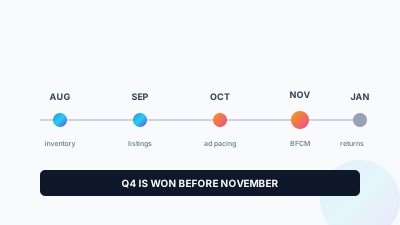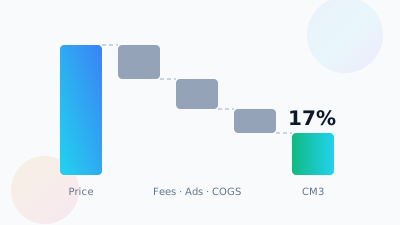
- Amazon charges holiday peak fulfillment fees on units shipped between October 15, 2026 and January 14, 2027, about $0.32 per unit more than off-peak on average in the US.
- Amazon adds its 3.5% fuel and logistics surcharge to peak fulfillment fees, and that surcharge is not included in the published rate card.
- Peak rates depend on size tier, weight and three price bands: below $10, $10 to $50, and above $50.
- Holiday purchases on Amazon.com dated November 1 to December 31, 2026 stay returnable through January 31, 2027, and Amazon says this window now repeats every year.
- Standard-size FBA storage is widely reported at about $2.40 per cubic foot per month in the last quarter, roughly triple the rest of the year.
- Hold a returns reserve on holiday sales until February instead of treating December revenue as final.
What changes for Amazon sellers this 2026 holiday season?
Three things shape holiday 2026 margins. FBA peak fulfillment fees cover units shipped October 15, 2026 until January 14, 2027, averaging about $0.32 more per unit. Purchases from November 1 to December 31 can be returned until January 31, 2027, now an annual rule. Q4 storage rates and promotion fees sit on top.
None of these is a surprise on its own. What is different this year is how they overlap. The peak fee window started before Black Friday deals were even locked, the 3.5% fuel and logistics surcharge Amazon added on April 17, 2026 stacks on top of peak rates, and Amazon has now said the extended return window will repeat every year, so holiday return risk is a permanent part of Q4 planning.
- Peak fulfillment fees: in force October 15, 2026 until January 14, 2027 for Buy with Prime, Multi-Channel Fulfillment, FBA and Remote Fulfillment with FBA. Amazon says the seasonal uplift per unit matches 2025, averaging about $0.32 in the US.
- Fuel and logistics surcharge: 3.5%, applied on top of the peak fulfillment fee, per Amazon's holiday announcement as reported by PPC Land.
- Extended returns: holiday purchases dated November 1 to December 31, 2026 stay returnable through January 31, 2027. Apple brand products have a January 15, 2027 cut-off.
- Promotion fees: Best Deals, Lightning Deals and Prime Exclusive Discounts cost $100 per promotion plus 1.5% of promotional sales, with the variable part capped at $5,000.
If you have not yet worked through the operational side of Q4, start with our Q4 and BFCM readiness playbook. This guide focuses on the money.
What are the 2026 holiday peak fulfillment fee rates?
Peak rates depend on size tier, shipping weight and selling price band: below $10, $10 to $50, and above $50. For a typical branded item priced $10 to $50, peak rates run from $3.51 for the smallest standard parcels to $7.51 for large standard items between 3 and 20 lb, before the 3.5% surcharge.
A note on sourcing: Amazon publishes the full rate card inside Seller Central, which requires a login, and its public summary gives only the $0.32 average. The figures below are selected rows of the 2026 to 2027 US peak rate card as reproduced by AMZ Prep. We cross-checked three rows against a separate reproduction by beBOLD, and they matched. Confirm your own SKUs in the Fee and Economics Preview Report, Profit Analytics or the Revenue Calculator, which Amazon says now show peak rates.
US peak FBA fulfillment fee per unit, non-apparel, selected rows
| Size tier and shipping weight | Priced $10 to $50 | Priced under $10 | Priced over $50 |
|---|---|---|---|
| Small standard, up to 2 oz | $3.51 | $2.62 | $3.77 |
| Small standard, over 14 oz up to 16 oz | $4.18 | $3.17 | $4.44 |
| Large standard, up to 4 oz | $3.97 | $3.15 | $4.23 |
| Large standard, over 8 oz up to 12 oz | $4.48 | $3.66 | $4.74 |
| Large standard, over 1 lb up to 1.25 lb | $5.34 | $4.52 | $5.60 |
| Large standard, over 2.75 lb up to 3 lb | $7.08 | $6.26 | $7.34 |
| Large standard, over 3 lb up to 20 lb (base, plus $0.08 per extra 4 oz) | $7.51 | $6.69 | $7.77 |
| Small bulky, up to 50 lb (base, weight charges extra) | $8.59 | $7.82 | $8.59 |
| Large bulky, up to 50 lb (base, weight charges extra) | $10.39 | $9.62 | $10.39 |
| Extra-large, up to 50 lb (base, weight charges extra) | $29.06 | $28.29 | $29.06 |
Apparel and dangerous goods have their own, higher peak tables. Canada averages about CAD $0.39 more per unit over its non-peak rates, on the same dates.
Peak versus non-peak on three common rows ($10 to $50 band)
| Row | Non-peak 2026 | Peak | Seasonal increase |
|---|---|---|---|
| Small standard, over 2 oz up to 4 oz | $3.42 | $3.61 | $0.19 |
| Large standard, over 8 oz up to 12 oz | $4.20 | $4.48 | $0.28 |
| Large standard, over 1.75 lb up to 2 lb | $5.82 | $6.15 | $0.33 |
Two mechanics matter. The fee is set by the date a unit leaves the fulfillment center, so an order placed October 14 that ships on October 15 pays the peak rate. And the 3.5% surcharge is not included in the published rate card, so multiply the peak rate by 1.035 for your true per-unit figure. Our breakdown of 2026 FBA fee changes and margin impact covers the base fee rise that took effect earlier in the year.
Do peak storage or other inventory fees apply in Q4?
Yes. Monthly FBA storage for standard-size items is widely reported at about $2.40 per cubic foot in October, November and December, roughly three times the January to September rate. Aged inventory surcharges, the storage utilization surcharge and the low-inventory-level fee can also apply, and promotion fees add a fixed cost per deal.
Storage is the line sellers most often leave out of holiday margin models because it is billed at account level, not per order. The $2.40 figure appears consistently in third-party fee guides, but the off-peak comparison differs: some put it near $0.78 per cubic foot and one, Nova Analytics, reports a change to $0.87 from July 1, 2026. We could not access Amazon's current storage rate card without a Seller Central login, so check yours before you budget.
- Monthly storage: charged on average daily cubic feet, billed the month after. Stock that arrives on October 1 pays the Q4 rate for every month it sits.
- Aged inventory surcharge: applies on top for older units. Third-party sources disagree on whether the trigger is now 180 or 181 days, so check your Inventory Age report rather than relying on a rule of thumb.
- Low-inventory-level fee: separate from the peak fee, and it can apply when stock runs low relative to demand. Check the Inventory Health page for SKUs flagged before peak.
- AWD carve-out: Amazon says sellers who send stock through Amazon Warehousing and Distribution with automatic replenishment to FBA keep the off-peak AWD storage rate through October 31, 2026.
- Deal fees: $100 per promotion plus 1.5% of promotional sales, variable part capped at $5,000. Amazon offered a $50 discount for early submission, and those early windows have closed.
Which sellers feel holiday costs most, and who is exempt?
FBA sellers of low-priced, heavier standard-size items feel the peak fee most, because a fixed per-unit increase eats a larger share of a small margin. Peak fulfillment fees do not apply to orders you ship yourself, but the extended return window covers every item sold on Amazon.com, FBA or FBM.
- Pay peak fulfillment fees: units sent out by Amazon for FBA, Multi-Channel Fulfillment, Buy with Prime or Remote Fulfillment with FBA, if they leave the warehouse between October 15, 2026 and January 14, 2027.
- Do not pay peak fulfillment fees: Merchant Fulfilled orders. They do face the January 31 return deadline, and, separately, a reported prepaid return label requirement from December 18, 2026, which changes how FBM returns are labeled and refunded.
- Hit hardest: SKUs priced just above $10, where the $10 to $50 band applies, and gift-heavy categories where holiday returns run above normal.
- Least affected: high-priced items where a 20 to 40 cent fee change is a rounding error, as long as return rates stay steady.
- Apple brand products: a shorter holiday return deadline of January 15, 2027.
Low-Price FBA items priced under $10 still pay peak charges during the window; they simply use the under-$10 column of the rate card.
How does the extended holiday return window work in 2026?
Holiday purchases on Amazon.com dated November 1 to December 31, 2026 stay returnable through January 31, 2027. Apple brand products must go back by January 15, 2027. The window applies automatically to FBA and FBM, sellers cannot opt out, and Amazon says the policy now applies every year.
The details come from an Amazon Seller News post dated October 16, 2026, reported by PPC Land. Amazon said existing return and refund conditions stay the same and no seller action is needed. We could not view the post directly, as Seller News requires a Seller Central login.
What the dates mean in practice:
- A purchase on November 1 can come back up to 91 days later. Under the normal 30-day rule it would have closed in early December.
- A purchase on December 31 gets about the usual allowance, so the extension matters most for early-season orders, including Black Friday and Cyber Monday.
- The Seller News post counts from the purchase date, while Amazon's standard policy counts from delivery. For late December orders delivered in January, the two clocks may differ. Amazon has not clarified this.
- The general deadline lands 17 days after peak fulfillment fees end, so the fee season closes before the return season does.
Revenue, ad return and contribution margin reported in the first week of January can still move as late returns arrive. Decisions that hang off December results, such as Q1 reorders and January ad budgets, should use return-adjusted figures or a reserve.
How do you model holiday margin impact on one SKU?
Rebuild one SKU's unit economics three times: at regular price in a non-peak month, at regular price during peak, and at your deal price during peak. Include the peak fee with surcharge, Q4 storage, deal fees and a higher holiday return allowance. The gap between the three shows how deep you can discount.
Every input below is an assumption for a made-up product, except the two fulfillment rates, which come from the reproduced 2026 rate card rows above. Use your own figures.
The made-up SKU: a $30 large standard item, 10 oz, about 0.06 cubic feet. Assumptions: $8.00 landed cost, 15% referral fee, $4.00 of ad spend per unit sold, one month of average storage, a 6% return rate normally and 10% for holiday purchases, and a $6.00 net loss per return. Storage uses $0.87 per cubic foot off-peak and $2.40 in Q4.
| Per unit | Regular price, non-peak | Regular price, peak | 20% off deal, peak |
|---|---|---|---|
| Selling price | $30.00 | $30.00 | $24.00 |
| Referral fee (assumed 15%) | $4.50 | $4.50 | $3.60 |
| FBA fulfillment incl. 3.5% surcharge | $4.35 | $4.64 | $4.64 |
| Landed product cost (assumed) | $8.00 | $8.00 | $8.00 |
| Storage allocation | $0.05 | $0.13 | $0.13 |
| Ad spend per unit (assumed) | $4.00 | $4.00 | $4.00 |
| Return allowance (rate x $6.00) | $0.36 | $0.60 | $0.60 |
| Deal fee: 1.5% of price plus $100 over an assumed 500 units | $0.00 | $0.00 | $0.56 |
| Contribution per unit | $8.74 | $8.13 | $2.47 |
Read it this way. Peak fees, storage and a higher return allowance together cost this made-up SKU $0.61 per unit, about 7% of its contribution. That is manageable. The deal is the bigger lever: a 20% discount cuts contribution per unit by roughly 70%, so the deal needs to sell more than three times the regular unit volume just to earn the same total profit, before you account for any halo on organic rank.
Watch the price bands. A SKU at $10.99 that you discount to $9.99 moves into the under-$10 column, which lowers the fulfillment fee. A SKU at $52 discounted to $45 moves from the over-$50 column down to the $10 to $50 column. Our contribution margin guide explains how to build this model across a full catalog.
What pricing and promotion plan works from Black Friday through January?
Concentrate discounts where demand is highest and returns risk is easiest to price: Black Friday through Cyber Monday. Hold or lift prices in mid-December as shipping cutoffs approach, and shift January spend toward self-purchase products, because peak fees last until January 14 while late returns from early-season orders keep arriving.
The phases below assume you already have deals booked. Black Friday and Cyber Monday deal submissions closed on October 20, 2026, and the FBA inbound deadline for those events with Amazon-optimized shipment splits is October 28, 2026.
- Now to mid-November: run regular prices with light coupons on hero SKUs to build sales history and rank. Amazon has said Prime Big Deal Days prices are excluded from the lookback that sets the maximum price for Black Friday and Cyber Monday deals, so October discounts should not block your November deals.
- Black Friday through Cyber Monday (November 27 to 30): put your deepest discounts on SKUs with the strongest contribution margin in the model above, not your thinnest-margin bestsellers. Raise ad budgets on those SKUs only.
- Early to mid-December: step discounts down. Gift buyers in this period care more about delivery date than price. Keep ads on, but cap bids at the margin each SKU can carry at peak fees.
- Late December: once delivery before Christmas is no longer possible, pull back on gift-only SKUs and keep spend on products people buy for themselves.
- January 1 to 14: peak fees still apply. Avoid clearance pricing on standard-size items until January 15, when fees fall back to non-peak rates, unless storage costs or aged inventory make waiting more expensive.
- January 15 onward: run clearance and replenishment decisions on return-adjusted numbers, not gross December sales.
For deal mechanics and when coupons beat Prime Exclusive Discounts, see our deals and coupons profitability guide.
How much should you reserve for late holiday returns?
Reserve the expected net cost of returns on every unit sold from November 1 to December 31, and hold it until February. Use your own return rate for last year's holiday purchases, measured by purchase date through January 31, multiplied by your net loss per return. Release what you do not use.
Amazon has published no holiday return rate figures, and neither has any source we reviewed, so this must come from your own data. A simple method:
- Pull last year's numbers by purchase date. Take units sold from November 1 to December 31, 2025, and count how many were returned by January 31, 2026. That is your holiday return rate per SKU or per category.
- Price each return. Net loss per return is the refund you do not recover, plus any return shipping you pay, plus the landed cost of units that cannot be resold.
- Calculate the reserve. Holiday units sold x holiday return rate x net loss per return. Book it as a liability in your management accounts, not as cash you can spend on Q1 inventory.
- Track it weekly. Compare actual returns against the reserve every Monday in January. If returns run ahead, cut January reorders before they ship.
- Release in February. Once the January 31 deadline passes and in-transit returns are received, release the unused balance.
Our refund cost analysis guide shows how to break returns down by reason so you can cut the avoidable share before next season.
Step-by-step holiday 2026 margin plan
Work through this list over the next two weeks. It moves from fee data, which you can confirm today, to pricing and reserves, which depend on it. Each step produces a number you can hand to whoever sets prices, approves ad budgets or signs off on January reorders.
- Download the Fee and Economics Preview Report and confirm the peak fee, size tier and price band for each active FBA SKU.
- Check dimensions on your top 20 SKUs. A wrong measurement can push a unit into a higher tier for the whole peak period.
- Apply the 3.5% surcharge to every peak fee that does not already include it.
- Estimate Q4 storage from average cubic feet on hand, using the rate shown in your account.
- Run the three-scenario model for each SKU: non-peak, peak at full price, peak at deal price.
- Rank deal SKUs by contribution after the deal, and cut any deal that needs an unrealistic volume lift to break even.
- Set ad bid caps from the peak-season contribution, not the regular one. Our Amazon PPC agency team builds these caps into holiday bidding rules.
- Calculate the returns reserve from last year's holiday return rate and set a weekly January check.
- Plan the January 15 switch: list the clearance and price changes that wait until fees drop.
What mistakes should you avoid, and which dates matter?
The common mistakes are using the $0.32 average instead of your SKU's actual rate, forgetting the surcharge and Q4 storage, judging Black Friday deals on revenue, and placing Q1 reorders off gross December sales. The dates below are the ones to put in your calendar now.
- Treating $0.32 as a flat fee. It is an average. Your increase depends on tier, weight and price band.
- Counting the surcharge twice, or not at all. Amazon's tools may already include it; the rate card does not.
- Ignoring the ship date rule. Fees follow the day a unit leaves the warehouse, not the order date.
- Booking December as final. Holiday purchases stay returnable to January 31, and Amazon now says this repeats every year.
- Overstocking into Q4 storage. Every unit sitting through December pays the highest monthly rate of the year.
| Date | What it means |
|---|---|
| October 15, 2026 | Peak fulfillment fees start for units shipped from this date |
| October 28, 2026 | FBA inbound deadline for Black Friday and Cyber Monday, Amazon-optimized splits |
| October 31, 2026 | End of off-peak AWD storage rate for auto-replenishment users |
| November 1, 2026 | Extended return window begins for new purchases |
| November 27 to 30, 2026 | Black Friday through Cyber Monday |
| December 31, 2026 | Final purchase day inside the extended window |
| January 14, 2027 | Last day of peak fulfillment fees |
| January 15, 2027 | Non-peak fees resume; Apple holiday return deadline |
| January 31, 2027 | Holiday return deadline for all other items |
Sources and data notes
Facts in this article were checked against the sources below on October 24, 2026. Amazon changes programs and dates often, so confirm details in Seller Central or the Amazon Ads console before you act.
- PPC Land: Amazon freezes 2026 holiday seller fees, cuts inbound windows shorter
- PPC Land: Amazon makes its January 31 holiday return deadline an annual rule
- AMZ Prep: 2026-2027 Holiday Peak FBA Fulfillment Fees for USA and Canada
- beBOLD: Amazon 2026 holiday fees guide
- Ordoro: Amazon holiday fees 2026
- Saltbox: Amazon holiday FBA fees
- sellerboard: FBA storage fees, the silent margin killer
- Nova Analytics: Amazon FBA storage fee overhaul H2 2026
Frequently Asked Questions
When do Amazon holiday peak fulfillment fees start and end in 2026?
Peak fees cover units that leave Amazon's warehouses between October 15, 2026 and January 14, 2027. FBA, Buy with Prime, Multi-Channel Fulfillment and Remote Fulfillment with FBA are all included. The charge depends on when a unit ships from the fulfillment center, and non-peak rates return on January 15, 2027.
How much is the Amazon peak fulfillment fee per unit in 2026?
Amazon says the US increase averages about $0.32 per unit above off-peak pricing, unchanged from 2025. The real figure depends on the SKU's size tier, weight and price band. For example, a large standard item of 8 to 12 ounces priced $10 to $50 is reported at $4.48 at peak versus $4.20 off-peak.
Does the 3.5% fuel surcharge apply to holiday peak fees?
Yes. Amazon's holiday announcement says the 3.5% fuel and logistics surcharge is added to the peak fee as well. The published rate card excludes it, so multiply the peak rate by 1.035 unless the Amazon tool you are using already shows the surcharge included.
What is Amazon's holiday return policy for 2026?
Holiday purchases on Amazon.com dated November 1 to December 31, 2026 stay returnable through January 31, 2027. Apple brand products must be returned by January 15, 2027. The window applies automatically to FBA and FBM sellers, and Amazon says the extended holiday policy will now apply every year.
Do FBM sellers pay Amazon holiday peak fees?
No. Peak fulfillment fees apply to units Amazon fulfills, such as FBA and Multi-Channel Fulfillment. Merchant Fulfilled orders do not pay them. FBM sellers are still covered by the extended holiday return window and, according to reporting on an Amazon email, a prepaid return label requirement from December 18, 2026.
Are Amazon FBA storage fees higher in Q4?
Yes. Monthly storage fees for standard-size items are widely reported at about $2.40 per cubic foot during October, November and December, around three times the rate for the rest of the year. Sources disagree on the exact off-peak figure, so confirm current rates in Seller Central before budgeting holiday inventory.
How should Amazon sellers account for late holiday returns?
Set aside a reserve equal to holiday units sold, multiplied by your historical holiday return rate, multiplied by the net loss per return. Hold it until returns stop arriving after January 31, then release the unused part. Use return-adjusted figures, not gross December sales, for Q1 reorders and ad budgets.
Want your holiday numbers checked SKU by SKU?
SellerVine can rebuild your peak-season unit economics, deal plan and returns reserve from your own Seller Central data before Black Friday.
Get a free account audit