The Promotion Menu, Briefly
Amazon offers several promotional formats and they are easy to confuse, partly because the names have shifted over the years. The distinctions matter because the costs and the eligibility rules differ.
- Lightning Deals. Short bursts, typically a few hours, shown on the deals pages with a claimed percentage bar and a countdown. High visibility, high urgency, fee charged per deal.
- Best Deals. Longer running, often a week or two, less urgent presentation but far more total exposure. Also fee bearing.
- Coupons. A clickable badge on the search results and detail page. The shopper ticks it, the saving applies at checkout. You pay the discount plus a fixed fee for each redemption.
- Prime Exclusive Discounts. Restricted to Prime members, presented as a price reduction rather than a badge to click. Usually free to run outside major events, with a fee during peak events such as Prime Day.
- Promotions and price discounts. The plain sale price with a strikethrough, subject to eligibility on your recent pricing history.
The visibility ranking roughly tracks the cost ranking, which is not a coincidence. Lightning Deals during a major event buy the most attention and charge the most for it. A coupon is cheap, always available and far less prominent.
What Each One Actually Costs You
There are three separate costs in any promotion, and sellers usually only think about the first one.
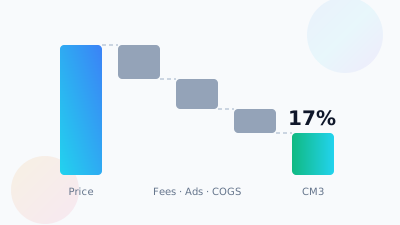
The discount. This is the obvious cost, and it is larger than the headline percentage suggests because it comes off the top line rather than out of profit. Twenty percent off the price is not twenty percent of your margin. On a product where contribution margin is forty percent of the sale price, a twenty percent discount removes half your profit per unit.
The platform fee. Lightning Deals and Best Deals carry a fee per deal that varies by marketplace and by season, rising sharply around Prime Day and the Black Friday period. Coupons charge per redemption. Prime Exclusive Discounts are typically free outside event windows. Fee levels change, so read the figure Amazon shows you at the point of scheduling rather than trusting a number you remember from last year.
The referral fee offset. One small piece of good news. Because the referral fee is a percentage of the selling price, discounting also reduces the fee Amazon takes. It softens the blow by roughly the referral rate, commonly around fifteen percent of the discount amount. It is real, it belongs in the model, and it is nowhere near enough to rescue a bad promotion.
An unclipped coupon costs nothing. That makes coupons the cheapest way to test whether a price badge moves conversion on a listing, because a failed test bills you almost nothing while a failed Lightning Deal has already charged the deal fee.
The Reference Price Trap
This is the mechanic that quietly damages sellers who promote frequently, and it deserves more attention than it gets.
Amazon generally requires a promotional price to be at or below the lowest price your item has recently sold for, typically measured over the previous thirty days, often with a minimum percentage reduction on top. The rule exists to stop sellers inflating a price in order to stage a fake discount, which is reasonable. The consequence is that every discount you run resets the benchmark for the next one.
Run a twenty percent promotion in October and your reference price for November is the promotional price, not your list price. To qualify for a Black Friday deal you now have to go below that. Do this three or four times in a season and you have walked your product down a staircase you cannot easily climb back up, because raising the price later costs you conversion and rank at exactly the moment competitors are discounting.
Sellers hit this every year and describe it as Amazon rejecting their deal for no reason. The system is behaving exactly as designed. The mistake happened weeks earlier, when a discount was run without considering what it did to the floor.
The practical discipline is to plan a season's promotions together rather than one at a time. Decide the lowest price you are willing to reach at the deepest point of the year, usually the main event, and work backwards so that earlier promotions stay above it. Sellers who protect their reference price in September still have room to compete in November.
The Break-Even Math, Worked
Here is the calculation that should precede every promotion. Take a product at $40 with a fifteen percent referral fee, $6 of FBA fees and $12 of landed cost.
At full price, the contribution per unit is the selling price less the referral fee, the FBA fee and the cost of goods. That is $40 less $6 in referral fees, less $6 of FBA fees, less $12 of product cost, leaving $16 per unit.
Now apply a twenty percent discount, taking the price to $32. The referral fee falls to $4.80, the other costs are unchanged, and the contribution becomes $9.20. You have kept fifty seven percent of your previous profit per unit.
To make the same total profit you now need to sell $16 divided by $9.20, which is 1.74 times as many units. A seventy four percent volume increase, just to stand still. Add a deal fee of $150 spread across, say, 300 units and the contribution drops to $8.70, pushing the required lift to about eighty four percent.
The same arithmetic makes coupons look considerably better. A ten percent coupon on the same product takes the price to $36, the referral fee to $5.40, and adds roughly $0.60 of redemption fee, leaving about $12 of contribution. The required lift is $16 divided by $12, about thirty three percent. A third more units is a target a decent listing can genuinely hit, which is why shallow coupons are frequently the most defensible promotion on the menu.
Run this calculation on your own numbers before you schedule anything. The inputs take two minutes to assemble and the answer regularly changes the decision. Sellers who do it once tend to do it forever, because the first time is usually a surprise.
The Halo Argument, Assessed Honestly
The standard defence of an unprofitable deal is that the direct maths understates the benefit. Extra sales lift organic rank, the rank persists after the deal, the review count grows, and the product emerges stronger. There is genuine truth in this, and it is also the argument used to justify a great deal of avoidable loss.
What is true: velocity and conversion do influence organic placement, and a well executed deal frequently produces a visible rank improvement that outlasts the promotion. For a new product with no sales history, buying velocity to escape the cold start problem can be a sensible investment, and treating it as marketing spend rather than a margin failure is the right framing.
What is less true: the effect decays, often within weeks. Rank gained through a temporary price is partly rank gained because the price was temporarily attractive, and when the price returns, conversion falls back toward its natural level. There is also a post deal trough, where the customers who would have bought at full price in the following fortnight have already bought at a discount.
Two further costs rarely make it into the halo argument. Deep discounts attract a more price sensitive buyer, and those cohorts tend to return goods at higher rates and leave harsher reviews, because expectations calibrate to what people paid. And on Subscribe and Save products, a promotional price can reset what long term subscribers pay, quietly reducing the value of your most profitable customers.
Use the halo argument where it applies, which is launches, genuine clearance and strategic event participation. Do not use it as a blanket justification for promoting a mature product that was selling perfectly well at full price.
When Deals Genuinely Work
There are four situations where the numbers routinely justify promoting, and it is worth being clear about them because the answer is not that deals are bad.
- Clearing inventory that is costing you money to hold. Aged stock accruing long term storage charges, or units approaching an expiry or seasonal cliff, have a carrying cost that makes a discounted sale better than a warehoused unit. Here the comparison is not against full price, it is against removal fees and write offs.
- Launching into a category where nobody has heard of you. Early velocity buys visibility that is otherwise slow and expensive to acquire. Budget it as launch investment with a defined end date.
- Major event participation. During Prime Day and the Black Friday window, traffic is abnormally high and shoppers are specifically hunting for discounts. Conversion rates on deals during these windows can exceed normal periods by enough to change the maths materially.
- Defending a rank position under attack. When a competitor is discounting aggressively into your keyword and taking share, a temporary response can be cheaper than rebuilding rank later. This is a defensive move with a time limit, not a pricing strategy.
What these share is a purpose other than immediate profit, defined in advance, with a measurable endpoint. Promotions go wrong when the goal is vague, when there is no plan to return to full price, and when nobody agreed beforehand what success would look like.
Making the Call
Before scheduling any promotion, answer four questions in writing. What is the contribution margin per unit today. What does it become at the promotional price including fees. What volume multiple is required to break even. And what are we actually buying if we do not hit it.
If the honest answer to the last question is nothing in particular, do not run the deal. If it is inventory clearance, rank for a launch, or event visibility you have decided is worth paying for, run it deliberately with a defined budget and a return to full price already scheduled.
Then measure what happened. Not just units during the window, which will obviously rise, but total contribution across the promotion and the fortnight afterwards, compared with an equivalent prior period. That comparison is where the trough shows up, and it is the only number that tells you whether the promotion created value or simply moved it around. Sellers who track it build a genuine view of which promotions work for their catalogue, which is far more valuable than any general rule about whether deals are worth running.
Frequently Asked Questions
Only when the volume lift clears the break-even, which is higher than most sellers assume. A 20% discount on a product carrying a 40% contribution margin typically needs sales to roughly double just to hold total profit flat, before the deal fee. Lightning Deals are usually worth running for inventory clearance, launch velocity or event visibility rather than as a profit play.
Two costs apply: the discount itself, and a fixed redemption fee charged for each coupon actually used. The redemption fee has commonly sat around $0.60 per redemption in the US, though Amazon adjusts fees periodically, so confirm the current rate in Seller Central before modelling. Unredeemed coupons cost nothing.
Amazon generally requires a promotion price at or below the lowest price the item sold for in the trailing period, usually 30 days, and often a minimum percentage off as well. If you have already been discounting, you have lowered your own reference price, so the bar for the next promotion is lower still and harder to clear.
Indirectly. Deals drive sales velocity and conversion, and both influence organic placement, so a successful deal often lifts rank for a period afterwards. The effect decays, and it is not reliable enough to justify a loss-making promotion on its own. Treat rank lift as a bonus, not as the business case.
A coupon is visible to all shoppers as a clickable badge and charges a fee per redemption. A Prime Exclusive Discount is restricted to Prime members, shows as a strikethrough style saving, and typically requires a minimum discount off your recent lowest price. Prime Exclusive Discounts usually carry a fee only during major shopping events.