The Report Most Sellers Don't Know Exists
Ask most sellers what report they use for keyword strategy and you'll hear about the search term report inside Sponsored Products, or Amazon's own keyword suggestion tools. Almost nobody brings up Search Query Performance, tucked inside Brand Analytics, and that's a genuine gap - it's the only report Amazon publishes that shows you your performance on a keyword relative to every other brand competing for that same search, not just relative to your own account history.
SQP requires Brand Registry enrollment to access, which is itself worth noting: if your brand isn't yet enrolled in Brand Registry, that's a prerequisite worth solving before anything else in this guide, because Brand Analytics data isn't visible without it.
What Makes SQP Different From Everything Else in Seller Central
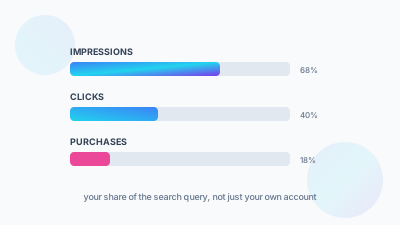
Every other performance report in Seller Central shows you your numbers, in isolation. Your impressions, your clicks, your conversion rate. SQP shows you your numbers as a share of the total market for a given search query - total category impressions for "stainless steel water bottle," and what percentage of those impressions, clicks, cart adds, and purchases belonged to your ASIN versus every competitor who also showed up for that search. That reframing is the entire value of the report: it turns "how did we do" into "how did we do relative to what was actually available to win."
The Four Funnel Stages SQP Tracks
SQP breaks each search query into four sequential stages, each reported as both a total market number and your share of it: Impressions (how often the query returned results, and how often your ASIN was among them), Clicks (how often results were clicked, and your share of those clicks), Cart Adds (how often clicked products were added to cart, and your share), and Purchases (how often cart adds converted to a completed purchase, and your share).
Reported together, these four stages let you calculate something no other report gives you directly: your true click-through rate and conversion rate for a specific query, benchmarked against the entire competitive set for that exact search - not against your own account average, which tells you nothing about whether your account average is actually good.
Reading Share, Not Just Volume
The instinct when opening SQP for the first time is to sort by query volume and focus on the biggest numbers. That's a reasonable starting filter, but the diagnostic value is in the share columns, not the volume columns. A high-volume query where you already hold a strong share isn't where the opportunity is - you're already winning it. The opportunity is in high-volume queries where your share is meaningfully below what your overall catalog performance would predict, because that gap is a specific, addressable problem rather than a general "do better" instruction.
Diagnosing Problems: Visibility vs. Conversion
SQP's real power is in what the pattern across stages tells you about where in the funnel a given query is breaking down, because the fix is different depending on the answer.
High impression share, low click share: Shoppers are seeing you, and choosing someone else. That's a listing-presentation problem - main image, title, price, star rating, or badge (Amazon's Choice, Best Seller) relative to the competitors also appearing for that query. Fix the listing, not the ad spend.
High click share, low cart-add or purchase share: Shoppers are clicking through to your listing and then not converting relative to how well the click-through was going. That's a detail-page problem - pricing perception, review content, image gallery depth, or A+ Content not answering the objection that's costing the conversion. More traffic to a page with this pattern just buys more of the same disappointing outcome.
Low impression share on a high-volume relevant query: You're barely showing up at all for a search that clearly matters to your category. That's an indexing or relevance problem - the query likely isn't well-represented in your title, bullets, or backend search terms, and no amount of bidding fixes a term you're not indexed against in the first place.
Most keyword prioritization is done by volume alone, which treats a query you're winning the same as a query you're invisible on, as long as both have similar search volume. SQP lets you prioritize by opportunity size - volume multiplied by your visible gap - which is a fundamentally better way to decide where PPC and SEO effort actually goes next.
Finding Keywords You're Invisible On
Cross-reference SQP against your own keyword research or competitor ASIN research to find high-volume queries in your category where your ASIN doesn't appear in the SQP report at all - not low share, genuinely absent. That absence usually means one of two things: the term isn't represented anywhere in your indexed content, or a suppressed or restricted listing state is preventing you from surfacing for it. Either way, it's a findable, fixable gap that volume-only keyword tools won't surface, because they show you what people search for, not whether you're actually eligible to appear for it.
Turning SQP Into a PPC and SEO Priority List
Once you've segmented your top queries by the diagnostic pattern above, the action items sort themselves by discipline. Visibility gaps (low impression share) go to your SEO and content backlog - title, bullet, and backend search term updates. Click-share gaps go to your creative and pricing review - main image, price positioning, badge eligibility. Conversion gaps on the detail page go to A+ Content, review generation, and listing copy. And queries where you already hold strong share across every stage are exactly where PPC budget is safest to concentrate, because you already have proof the full funnel converts for that specific search.
A Simple Weekly SQP Routine
Pull the report weekly, sorted by query volume for your primary category terms. Scan for any query where your share drops meaningfully stage over stage - that drop point tells you which team owns the fix. Flag new high-volume queries entering your top list that you haven't reviewed before, since search behavior shifts seasonally and a query that didn't matter last quarter can matter significantly this quarter. And revisit queries you've already fixed roughly a month after the change, since SQP is also the fastest way to confirm whether a listing or content change actually moved the share numbers, rather than just assuming it did.
Frequently Asked Questions
It sits inside Brand Analytics, which requires Brand Registry enrollment to access. If your brand isn't enrolled yet, that's the prerequisite to solve first, because none of the Brand Analytics data is visible without it. Most sellers never open SQP, reaching for the Sponsored Products search term report or keyword suggestion tools instead.
Your share of the total market for a search query, not just your own numbers in isolation. SQP reports four sequential stages, impressions, clicks, cart adds, and purchases, as both a total market figure and the percentage that belonged to your ASIN. That lets you benchmark your click-through and conversion against the whole competitive set for that exact search.
Shoppers are seeing you and choosing someone else, which is a listing-presentation problem rather than an ad spend problem. Look at your main image, title, price, star rating, and badge status compared to the competitors also appearing for that query. Fix the listing itself, since more bidding won't change what shoppers decide in the search results.
Concentrate PPC on queries where you already hold strong share across every stage, since you have proof the full funnel converts there. Send low impression share queries to your SEO backlog for title, bullet, and backend term work. Click-share gaps go to creative and pricing. Detail-page conversion gaps go to A+ Content and reviews.