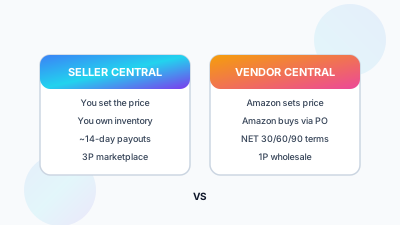
Vendor Central is a different job, not just a different dashboard
What is a Vendor Central agency? An amazon vendor central agency manages the first-party, wholesale relationship a brand has with Amazon as a retail buyer, purchase order and inventory planning, chargeback defense, co-op deduction audits, cost price negotiations, and retail analytics, rather than the third-party listing, advertising and fulfillment work a Seller Central agency handles. If you already understand the basic difference between Seller Central and Vendor Central as selling models, this article assumes that foundation and goes one level deeper: who should actually manage the Vendor Central relationship once you are in it.
If you have not yet settled the more basic question of whether Vendor Central or Seller Central is the right model for your business at all, our Seller Central vs Vendor Central comparison is the right starting point before this one. This article picks up from there, for the reader who is already on Vendor Central, or who has just been invited into it by Amazon's retail organization, and needs to decide who should run it.
That invitation is worth pausing on, because it is often not fully optional in the way choosing a selling model usually is. Amazon's retail team sometimes approaches a brand directly and proposes a vendor relationship, and while a brand can decline or negotiate terms, the timeline for figuring out who will manage that relationship can be shorter than a brand would choose on its own. Getting the "who manages this" question wrong under time pressure is exactly the situation this article is meant to help you avoid.
What a Vendor Central agency actually does day to day
The daily work of managing a Vendor Central account bears surprisingly little resemblance to running a Seller Central one. It centers on Amazon's retail buying relationship rather than a storefront you control directly, and a large share of it happens in email threads, negotiation calls, and spreadsheet reconciliation rather than in a campaign manager dashboard.
Purchase order and inventory planning
Amazon's retail team issues purchase orders based on their own demand forecasting, and a vendor has to plan production, inventory, and fulfillment capacity around POs it does not fully control the timing or size of. Managing this well means understanding Amazon's ordering patterns closely enough to forecast realistically, and knowing how to respond when a PO is smaller than expected, larger than expected, or arrives with unusual timing.
Chargeback prevention and dispute management
Vendor chargebacks, deductions Amazon applies for issues like packaging non-compliance, late shipments, or shortage discrepancies, are a routine and often significant cost of doing business on Vendor Central. Preventing them requires operational discipline around Amazon's routing guide and packaging requirements, and disputing them when they occur unfairly requires a specific process and a working relationship with the right Amazon contacts. This is a genuinely specialized skill, not a PPC-adjacent one.
Co-op deduction audits and CPI negotiations
Co-op deductions, fees tied to marketing and promotional agreements built into the vendor relationship, need regular auditing to confirm they match what was actually agreed. Cost price increase negotiations, raising the wholesale price Amazon pays for your product when your own input costs rise, require a structured commercial case and an entirely different kind of negotiating relationship with Amazon than anything a Seller Central account manager typically handles.
Retail analytics and vendor scorecard management
Amazon evaluates vendors against its own retail analytics and scorecard metrics, covering things like in-stock rate, on-time shipment, and chargeback rate. Managing a Vendor Central account well means actively tracking these metrics and treating scorecard health as a real, ongoing priority, not an afterthought that only gets attention when Amazon flags a problem.
How this differs from Seller Central account management
Seller Central account management is built around a storefront you directly control: your own pricing, your own listings, your own advertising campaigns, and your own choice of fulfillment method. Vendor Central management is built around a wholesale relationship where Amazon is the retail customer, buying your product to resell on its own terms. The skills genuinely do not overlap as much as the shared "Amazon" label suggests. A team that has spent years perfecting Seller Central PPC and listing optimization has not automatically built any expertise in PO forecasting, chargeback disputes, or CPI negotiation, because none of those things exist in the Seller Central world in the same form.
The reporting cadence differs too. A Seller Central team typically reports on advertising performance and organic rank on a weekly or monthly rhythm tied to campaign cycles. A Vendor Central team's reporting rhythm is shaped by Amazon's own PO cycle and chargeback processing timeline, which does not necessarily match a tidy monthly calendar, and by the pace of whatever negotiation, a CPI request or a disputed deduction, happens to be active at a given moment. Judging a Vendor Central agency by Seller Central reporting expectations is itself a small but telling sign of the two disciplines being conflated.
It is easy to assume "Amazon experience" is a single, transferable skill set. Vendor Central and Seller Central share a parent company and a login screen, and very little else in terms of the actual day-to-day work required to manage each one well.
Why some agencies claim both, but few are genuinely strong at both
Plenty of agencies list both Seller Central and Vendor Central management on their services page, because it is easy to claim and hard for a prospective client to verify quickly. Being genuinely strong at both requires maintaining two separate pools of specialized expertise, PPC and listing specialists for one, negotiation and retail analytics specialists for the other, which is a real organizational commitment, not a matter of adding a line to a website.
Picture a brand invited into Vendor Central by Amazon's retail team, assuming their existing Seller Central-savvy agency can simply extend coverage, only to discover months in that PO forecasting, chargeback disputes, and co-op negotiations require a genuinely different skill set and a different working relationship with Amazon's retail organization than anything the agency had built for Seller Central. Nothing about the original engagement was dishonest, the gap simply was not visible until the specific demands of Vendor Central surfaced it.
This is not a reason to distrust every agency claiming both capabilities. Some genuinely have built two real practices under one roof, with distinct team members, distinct processes, and distinct track records for each. The point is that the claim itself proves nothing either way, and it is on the buyer to ask for the specific evidence that separates a genuinely dual-capable agency from one stretching a single team across two disciplines it only partly understands.
In-house, general agency, or Vendor Central specialist: how to decide
The right structure depends on your specific pain points, not on defaulting to whoever already manages your Seller Central account. A brand facing a wave of chargeback deductions, for instance, has a very different need than a brand mainly wrestling with purchase order volume forecasting.
Picture a brand hit by a spike in shortage claim and chargeback deductions, discovering that the agency's real strength, PPC optimization, does not extend to defending those deductions at all. Or picture a brand approaching a cost price increase negotiation with Amazon and realizing it demands an entirely different negotiating relationship and skill set than a typical Seller Central optimization conversation. In both cases, the pain point itself points toward the kind of help actually needed, in-house hire, general agency, or dedicated Vendor Central specialist, rather than an assumption based on who is already in the room.
- In-house can work well if your PO and chargeback volume is manageable and you have someone with genuine retail buying or supply chain background already on the team.
- A general Amazon agency with real Vendor Central capability makes sense if you want a single point of contact across both selling models and can verify the Vendor Central side is genuinely staffed, not just listed.
- A dedicated Vendor Central specialist is worth prioritizing if chargebacks, co-op disputes, or CPI negotiations are your specific, recurring pain point, since depth in exactly those areas is what solves the problem fastest.
It is also worth revisiting this decision periodically rather than treating it as permanent. A brand that starts with in-house Vendor Central management because PO volume is manageable may find that chargebacks and co-op complexity grow faster than headcount does, at which point bringing in specialist support becomes the more efficient choice. Equally, a brand that starts with a specialist agency while building internal capability may eventually be ready to bring more of the work in-house once that expertise has been transferred. Neither direction is a sign of a wrong initial decision, it is simply a relationship that should scale with the actual complexity of the account.
What to ask a prospective Vendor Central agency
- Can you walk me through a chargeback dispute you have actually handled, not just a general description of the process?
- How do you approach cost price increase negotiations, and what is your track record specifically with CPI conversations?
- Who on your team owns Vendor Central work specifically, and is it the same team managing Seller Central accounts?
- How do you audit co-op deductions, and how often?
- What retail analytics and scorecard metrics do you track for vendor accounts, and how often do you report on them?
- Can you describe a purchase order forecasting challenge you have solved for a client?
Vendor Central vs Seller Central agency work at a glance
| Factor | Seller Central agency | Vendor Central agency |
|---|---|---|
| Relationship to Amazon | Seller, third-party (3P) | Vendor, first-party wholesale (1P) |
| Core day-to-day tasks | Listing optimization, PPC, reviews, FBA replenishment | PO planning, chargeback defense, co-op audits, CPI negotiation |
| Pricing model norms | Retainer, percentage of ad spend, or hybrid | Often retainer-based, sometimes with negotiation-linked fees |
| Typical KPIs tracked | ACoS, TACoS, conversion rate, organic rank | In-stock rate, chargeback rate, on-time shipment, scorecard health |
| Negotiation exposure | Generally minimal, mostly bid and pricing decisions | Ongoing: co-op terms, CPI negotiations, chargeback disputes |
| Inventory control | Seller-controlled, sent into FBA as decided | Vendor-side forecasting against Amazon-issued POs |
For hands-on tactical depth on specific Vendor Central problems rather than the agency-selection question this article covers, our existing operational guides go deep on each: purchase order cancellations, chargeback prevention, co-op deduction audits, CPI negotiations, and shortage claims disputes. A genuinely capable Vendor Central agency should already have mastered the ground covered in each of these, not be learning it on your account.
Where to go next
Vendor Central management is a distinct discipline, not a variation on Seller Central skills, and treating the two as interchangeable is how brands end up with an agency that is confident but under-equipped for the actual work in front of them. Whether the right answer for you is in-house, a general agency with real Vendor Central depth, or a dedicated specialist should follow from your specific pain points, chargebacks, co-op disputes, CPI pressure, or PO volume, rather than from whoever already happens to manage your Seller Central account. If your business also sells on amazon.co.uk or amazon.com and you want the country-specific hiring angle alongside this specialism-specific one, our guides on hiring an Amazon agency in the UK and hiring an Amazon agency in the United States cover that ground. For the broader, country-agnostic evaluation framework, see our complete guide to choosing an Amazon agency, and for what full-service Amazon operations support looks like at SellerVine, visit our operations agency page or browse our FAQ.
FAQs
What is a Vendor Central agency?
A Vendor Central agency manages the first-party, wholesale relationship a brand has with Amazon as a retail buyer, including purchase order and inventory planning, chargeback defense, co-op deduction audits, cost price negotiations, and retail analytics. It is a genuinely different discipline from Seller Central account management, which handles third-party listing, advertising, and fulfillment work.
Can the same agency manage both my Seller Central and Vendor Central accounts?
Some agencies genuinely can, but claiming both is easy while being strong at both is not. Ask for specific, checkable evidence of Vendor Central expertise separate from Seller Central case studies before assuming coverage extends across both models.
Do Vendor Central agencies charge differently than Seller Central agencies?
Pricing structures can differ because the work itself differs. Vendor Central engagements often involve more negotiation-heavy and analytics-heavy work (chargeback disputes, co-op audits, CPI negotiations) that some agencies price separately from standard account management retainers, rather than folding everything into one flat fee.
How do I know if I need a Vendor Central specialist instead of a general Amazon agency?
If your primary pain points are chargeback disputes, co-op deduction confusion, CPI negotiation pressure, or purchase order and inventory planning issues, a specialist with demonstrated Vendor Central experience is worth prioritizing over a generalist Amazon agency whose experience is mostly Seller Central.
What is the difference between Vendor Central and Seller Central in the first place?
Seller Central is the third-party model where you sell directly to customers and control pricing and fulfillment. Vendor Central is the first-party, wholesale model where Amazon buys your products via purchase orders and resells them as the retailer. Our dedicated comparison of the two models covers this decision in full.
What do Amazon Vendor Central management services include?
Typically purchase order management and confirmation, chargeback and shortage claim disputes, co-op and allowance reconciliation, cost price negotiation, catalogue and content maintenance, and 1P advertising. The finance recovery work, chargebacks and shortage claims, is usually where an agency pays for itself on a Vendor account.
Can an agency handle Vendor Central case management for me?
Yes, and on 1P accounts it is often the main reason to hire one. Vendor case work runs through a different support system than Seller Central and depends on submitting the right proof in the right format before deadlines expire. An agency running this weekly will recover deductions an in-house team without the time usually writes off.