1. Executive Summary & Macro-Economics of 1P Chargebacks
Amazon Vendor Central (1P) operations are governed by strict automated supply chain compliance protocols. When a manufacturer or distributor accepts an Amazon Purchase Order (PO), Amazon expects flawless execution across order confirmation, Electronic Data Interchange (EDI) transmissions, carrier appointment scheduling, carton labeling, and warehouse palletization.
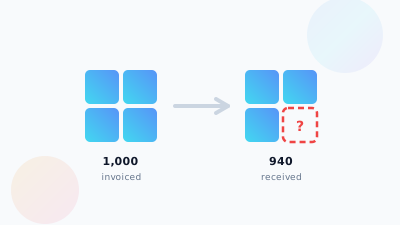
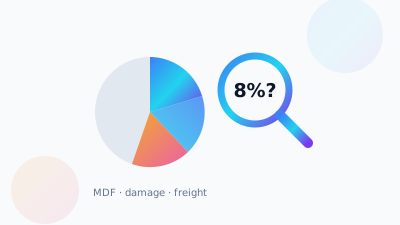
Whenever a vendor breaches fulfillment guidelines or carrier delivery windows, Amazon's receiving systems automatically generate monetary chargeback penalties. These penalties are deducted directly from your invoice payout remittance. Left un-monitored, operational chargebacks drain 3% to 8% of total gross 1P revenue, drastically eroding wholesale margins.
Amazon enforces a strict **30-day dispute window** from the date a chargeback deduction appears in your Vendor Central Financial Scorecard. Auditing chargeback notices weekly and submitting proof documentation recovers an average of **78% to 85% of invalid operational deductions**.
2. Comprehensive 2026 Vendor Central Chargeback Penalty Matrix
Operational chargebacks fall into five core logistical categories. Understanding the exact penalty calculations and root causes is essential for operational prevention:
| Chargeback Category | Penalty Rate / Calculation | Primary Root Cause | Dispute Success Rate |
|---|---|---|---|
| ASN On-Time Transmission Failure | 1% of PO Value ($150 min) | EDI 856 sent AFTER carrier pickup | 85% - 90% |
| Late Delivery / Missed Window | 3% - 5% of PO Invoice Value | Carrier missed FC appointment window | 75% - 82% |
| Unscannable Barcode Label | $5.00 per carton | Low-dpi printer / tape covering barcode | 88% - 94% |
| Packaging & Prep Non-Compliance | $15 - $25 per pallet / carton | Overweight cartons (>50 lbs) / loose pallets | 60% - 70% |
| Overage Shipment Units | 10% Unit Cost Surcharge | Shipped extra units not on EDI 850 PO | 65% - 75% |
3. Technical EDI Integration & Warehouse SOP Blueprint
To eliminate 1P chargebacks permanently, establish automated Electronic Data Interchange (EDI) workflows between your ERP system and Amazon's procurement API:
Pillar 1: Automate EDI 856 (Advance Shipping Notice) Transmission
Amazon requires the EDI 856 transmission to be successfully processed before the delivery truck arrives at the Amazon fulfillment center dock. Set your WMS/ERP to automatically trigger EDI 856 generation upon bill of lading (BOL) printing at your warehouse loading dock.
Pillar 2: Grade-A Thermal Barcode Label Standards
Unscannable barcode chargebacks occur when automated Amazon Cubiscan high-speed cameras fail to read master carton GTIN-14 or SSCC-18 barcodes. Print labels using 300 dpi thermal transfer printers on non-glossy 4x6 labels. Never cover barcodes with clear packing tape or stretch wrap.
Pillar 3: Strict Weight & Palletization Thresholds
Master cartons must not exceed 50 lbs unless labeled with explicit **'Heavy Package'** warning stickers. Pallets must adhere to standard 48" x 40" wooden GMA pallets with a maximum height of 72 inches and shrink-wrapped with at least 5 layers of stretch film.
4. Mathematical Dispute Recovery Model & Proof Document Matrix
When disputing invalid chargebacks in Vendor Central, your submission must contain verifiable proof documents. The matrix below outlines the exact evidence bundle required for each chargeback type:
| Chargeback Type | Required Document #1 | Required Document #2 | Key Validation Fields |
|---|---|---|---|
| ASN Failures | Timestamped EDI 856 Transmission Log | Signed Carrier BOL Pickup Receipt | EDI timestamp MUST precede carrier pickup time |
| Late Delivery | Carrier Bill of Lading (BOL) | CARP Gate Check-In Time Confirmation | Shows carrier arrived during appointment window |
| Unscannable Barcode | Grade-A Barcode Verification Report | High-Res Photo of Cartons Prior to Dispatch | Proves GTIN-14 label readability at dispatch |
5. Step-by-Step Vendor Central Dispute Submission Walkthrough
Step 1: Navigate to Operational Performance
In Vendor Central, select Payments > Operational Performance. Filter chargeback views by 'Action Required' and export monthly dispute CSV files.
Step 2: Isolate Carrier-Caused vs. Internal Operational Errors
If a late delivery chargeback was caused by an Amazon Preferred Carrier (Collect freight / FCA), Amazon is responsible for the delay. Submit carrier pickup logs for 100% reimbursement.
Step 3: Submit Dispute Case with Evidence PDF Bundle
Click 'Dispute' next to the specific chargeback ID. Attach a single merged PDF containing the PO invoice, packing list, EDI log, and stamped BOL. Clear, well-organized documentation accelerates approval within 5 to 10 business days.
Frequently Asked Questions
What is the exact deadline to dispute Vendor Central chargebacks?
Vendors must submit disputes within 30 calendar days from the date the chargeback deduction is posted to your Vendor Central Financial Scorecard.
Are vendors responsible for late delivery chargebacks on Collect (FCA) shipments?
No. On Collect shipments where Amazon manages carrier freight routing, vendors are only responsible for having freight ready by the Agreed Pickup Date. Submitting signed BOL pickup receipts voids 100% of carrier-caused late delivery penalties.
Can small vendors dispute chargebacks in bulk?
Yes. Vendor Central allows bulk dispute submissions using standardized Excel template upload sheets available in the Dispute Management portal.
Ready to Stop Vendor Chargeback Margin Leakage?
Book a complimentary consultation with SellerVine's 1P Operations & Audit team. We will audit your Vendor Central scorecards, build automated dispute workflows, and recover lost invoice revenue.
Book a Free 1P Audit Call