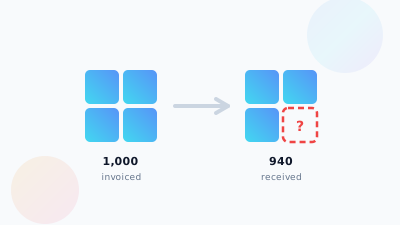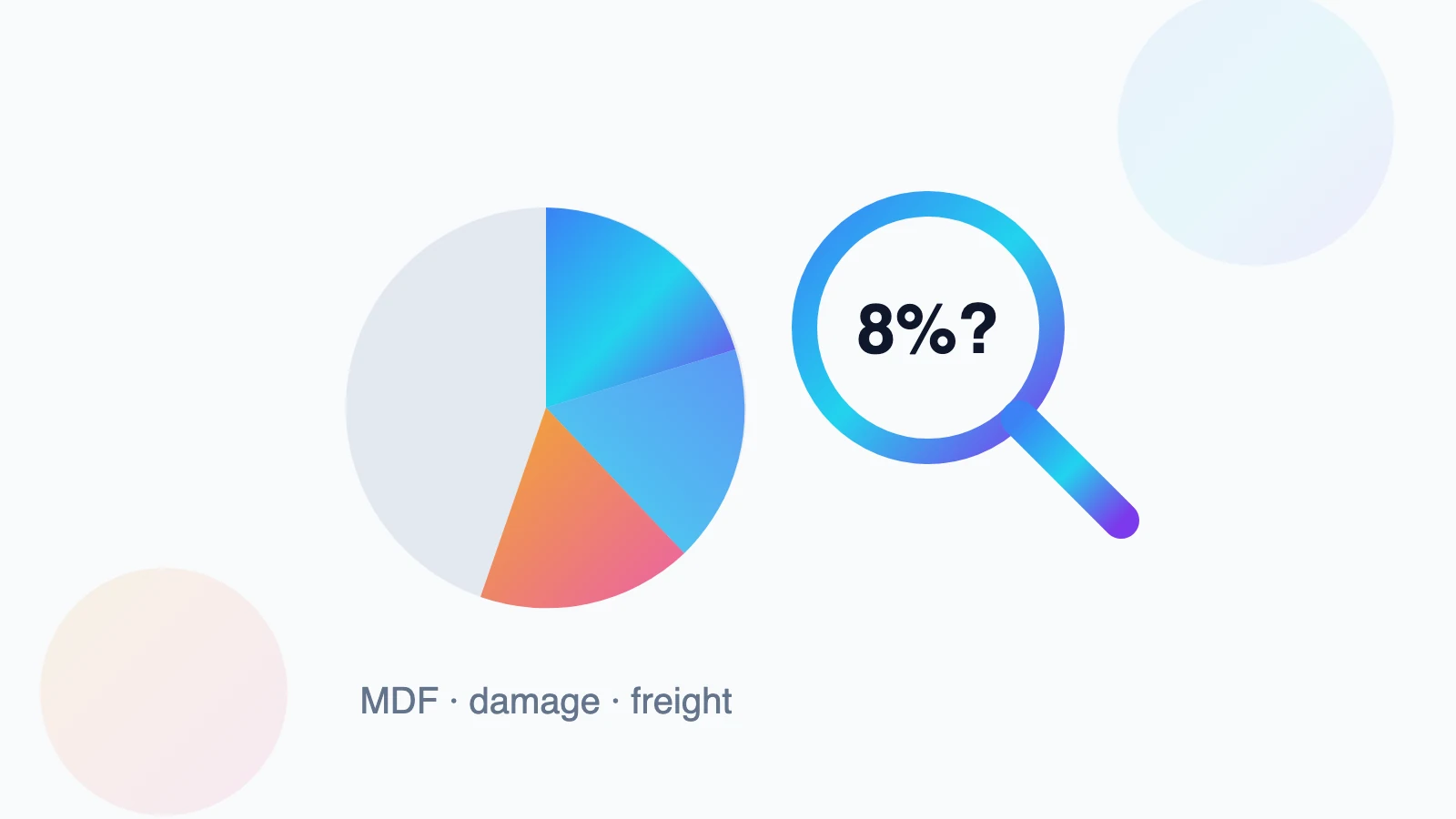
If you sell to Amazon as a 1P vendor, open your last payment remittance and look at the deduction lines. Somewhere in there you will find co-op charges - Market Development Funds (MDF), damage allowance, freight allowance, and possibly others - quietly shaving anywhere from 4% to 15% off every invoice before the money reaches your bank account.
Most vendors treat these deductions as background noise. That is exactly why over-billing persists: Amazon’s systems apply whatever percentages are recorded against your vendor code, and those records drift out of sync with your actual signed agreements more often than you would expect - after annual terms negotiations, after a buyer changes, after a catalog migration, or simply through data-entry error.
We have audited co-op deductions for vendors across almost every category, and it is rare to find an account with zero discrepancies. This guide walks through what each deduction actually is, how to reconstruct what you should be paying, and how to recover the difference when the numbers do not match.
What Co-Op Deductions Actually Are
Co-op (short for "co-operative advertising and services") is the umbrella term for the percentage-based allowances written into your Amazon Vendor Terms. Unlike chargebacks, which are penalties for specific operational failures, co-op deductions are contractual - you agreed to them, at specific percentages, when you signed your terms.
The most common lines you will see on remittances:
| Deduction | Typical range | What it nominally covers |
|---|---|---|
| Market Development Funds (MDF) | 5% to 10% | Amazon’s marketing of your products - placement, merchandising, promotional support |
| Damage / defect allowance | 1% to 3% | Product damaged in Amazon’s fulfilment network, in lieu of item-level claims |
| Freight allowance | 2% to 5% | Amazon arranging inbound freight collection (when Amazon manages transport) |
| Subscribe & Save funding | 0% to 5% | Funding the S&S discount on enrolled ASINs |
| Early payment discount | 1% to 2% | A discount in exchange for faster payment terms (e.g. Net 30 instead of Net 60) |
Key principle: every one of these numbers exists in a signed agreement. If a deduction appears on a remittance at a percentage you never signed - or for a program you never joined - it is recoverable.
Why Over-Billing Happens So Often
Amazon does not manually calculate your deductions each invoice. The percentages live in its vendor master data, and the payment system applies them automatically. Drift creeps in through predictable routes:
- Annual Vendor Negotiations (AVN): you agree to new terms effective January, but the old (higher) percentages keep being applied for weeks or months.
- Duplicate agreements: a new agreement is entered without terminating the old one, and both apply simultaneously - we have seen vendors paying MDF twice.
- Wrong scope: an allowance negotiated for one product line or vendor code gets applied across the entire catalog.
- Program remnants: you exited Subscribe & Save funding or a promotional program, but the accrual never stopped.
- Simple keying errors: 3% entered as 8%, a decimal in the wrong place. It happens more than anyone admits.
Because each deduction is a small percentage of a large number, errors hide well. A 2-point MDF discrepancy on $4M of annual receipts is $80,000 - invisible on any single remittance, very visible over a year.
The Audit Process, Step by Step
1. Assemble your contract baseline
Pull every signed agreement that touches allowances: your current Vendor Terms, the most recent AVN outcome, any program addenda (S&S, Born to Run, freight). Build a simple table: deduction type, agreed %, effective date, scope. This is your source of truth - the audit is meaningless without it.
2. Export the deduction history
In Vendor Central, go to Payments → Remittance and export line-level detail for at least 12 months. Co-op lines appear with agreement numbers attached. Group by agreement number and deduction type, and compute the effective percentage actually charged: deduction amount ÷ invoice base.
3. Compare, line by line
Lay actual percentages against your contract baseline by month. You are looking for three patterns: rates that never matched, rates that failed to update after a terms change, and deductions with no corresponding agreement at all.
4. Quantify and prioritise
Multiply each discrepancy by the affected receipts. Chase the biggest numbers first - disputes cost the same effort whether they recover $2,000 or $60,000.
Disputing Incorrect Deductions
Co-op disputes go through Vendor Central’s contact-us flow under Payments → Co-op / allowance dispute, and the quality of your submission determines the outcome. A winning dispute package contains:
- The agreement number and the exact clause showing the agreed percentage
- A month-by-month table of charged vs. contracted amounts, with the delta
- Remittance references for every affected payment
- One clear sentence stating the total amount claimed and the correction requested going forward
Two practical realities: Amazon’s dispute windows favour recent charges, so audit quarterly rather than annually - and fix the source (the recorded percentage) in the same case, or the over-billing simply resumes next remittance. Ask explicitly for confirmation that the master-data rate has been corrected.
Using Audit Findings in Your Next Negotiation
A completed co-op audit is also negotiation ammunition. Walking into an AVN knowing exactly what each allowance cost you last year - and what Amazon delivered for it - changes the conversation. MDF is the clearest example: if you paid 8% MDF and cannot point to a single merchandising placement, that is a data-backed argument for reducing the rate or converting it into funding you control, like AMS/advertising credits.
Vendors who audit consistently also make fewer concessions under deadline pressure, because they know which allowances are genuinely painful and which are tolerable. The audit turns "Amazon wants another point of MDF" from an abstract ask into a precise dollar figure you can trade deliberately.
Frequently Asked Questions
What is the difference between co-op deductions and chargebacks?
Co-op deductions are contractual, percentage-based allowances you agreed to in your vendor terms (MDF, damage allowance, freight allowance). Chargebacks are operational penalties for specific compliance failures like late shipments or labelling errors. Both reduce your remittance, but they are disputed through different processes and have different root causes.
What are standard co-op agreement percentages?
Damage allowances typically range from 1% to 3%, freight allowances from 2% to 5%, and MDF from 5% to 10%, depending on category and negotiating leverage. There is no single "standard" - what matters is what your signed agreement says, which is exactly why auditing against it matters.
How far back can I dispute incorrect co-op deductions?
Practically, recent charges are far easier to recover - Amazon responds best to disputes raised within the current and prior quarter. Older claims can succeed with strong documentation, but recovery rates drop with age. This is why we recommend a quarterly audit cadence rather than a single annual review.
Amazon is deducting for a program I never signed up for. What do I do?
Raise a dispute citing the absence of any agreement covering the deduction, and ask Amazon to produce the signed agreement it is billing under. If no agreement exists, request full reversal and termination of the accrual. Unattributable deductions are among the most commonly recovered.
Is MDF ever worth paying?
It can be - if it is actually spent on your products. The problem is opacity: many vendors pay MDF for years without visibility into what it funds. If you cannot see merchandising value, negotiate the rate down or convert it into advertising funding you control and can measure.