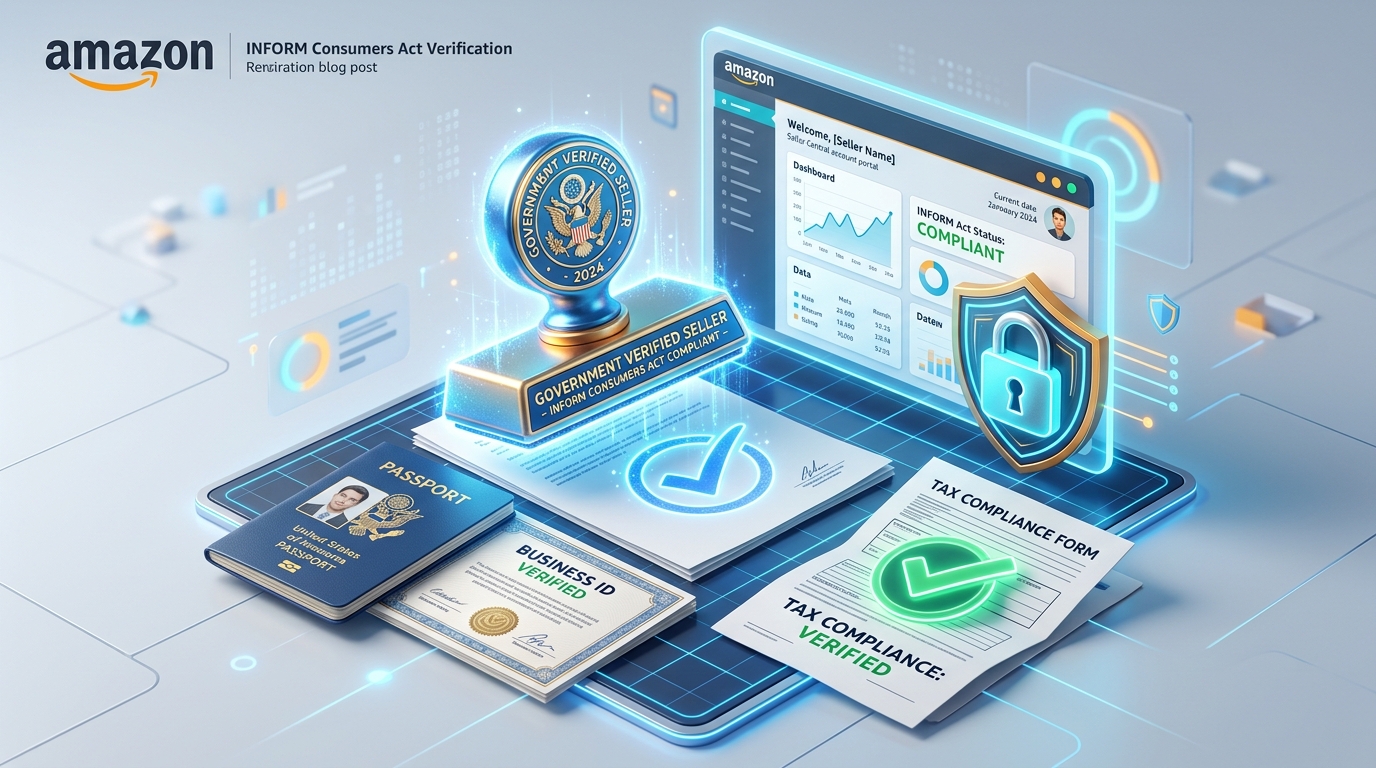
Since June 2023, a US federal law - the INFORM Consumers Act - has required Amazon to collect, verify, and keep current the real-world identity of its high-volume sellers: government ID, tax ID, bank account, and a working contact. It also requires Amazon to disclose seller identity to buyers above a revenue threshold, and - the part that catches sellers off guard - to suspend accounts within 10 days when verification is not completed.
In practice this shows up as an email or Account Health banner: "Action required: verify your information", with a countdown. Sellers who treat it as spam, or who submit mismatched documents, hit deactivation with revenue mid-flight - one of the most avoidable suspensions on Amazon.
This guide covers exactly who is affected, what triggers re-verification, the documents Amazon accepts, and how to clear verification cleanly - plus what happens to your data on the public side.
Who the Law Actually Affects
The Act defines a high-volume third-party seller as one with 200 or more discrete transactions AND $5,000 or more in gross revenue to US consumers in a continuous 12-month period during the previous 24 months. Cross that line and Amazon must collect and verify:
- Bank account information (or payee account)
- Government-issued ID for the individual, or tax documents for a business entity
- Tax identification number (SSN/EIN for US; equivalent for foreign entities)
- A working email and phone number
A second threshold matters: at $20,000+ in annual gross revenue, disclosure kicks in - your seller name, full business address, and contact information become visible to consumers on your seller profile page. Home-based sellers can request partial address disclosure protections, but the baseline is public identity.
Practically: almost every full-time seller is over both thresholds. The question is not whether INFORM applies to you - it is whether your registered data would survive verification today without a scramble.
What Triggers a Verification (and Re-Verification)
- Crossing the thresholds for the first time - new sellers hit this mid-growth
- Annual certification: the law requires sellers to certify data is current at least annually; Amazon prompts this in Seller Central
- Any change to registered data: new bank account, business address, legal entity change, ownership transfer - each can re-open verification
- Mismatch detection: Amazon cross-checks against IRS records, bank data, and ID documents; a name that differs by one word between your tax record and Seller Central can trigger a review
- Random and risk-based checks - particularly after policy events on the account
The dangerous scenario is the quiet drift: you changed banks 18 months ago, or your LLC’s registered address moved, and Seller Central still shows the old data. The verification email then arrives with a 10-day clock against records you have to fix before you can even pass.
The 10-Day Clock and What Deactivation Looks Like
The statute gives platforms 10 days after notice to obtain compliant information, failing which the account must be suspended. Amazon implements this literally: banner, escalating emails, then deactivation with funds held under the standard reserve rules until verification completes.
- Deactivation under INFORM is not a policy violation - Account Health is unaffected once resolved - but the revenue interruption is identical to any suspension
- FBA inventory keeps incurring storage fees while deactivated
- Reinstatement after completing verification is usually fast (days), but document mismatches restart the loop
Treat the first notification as a same-week priority, not an eventually task.
Passing Verification the First Time: Documents That Match
Nearly every failed verification is a mismatch problem. The records must agree with each other, character for character where it counts:
| Check | What Amazon compares | Common failure |
|---|---|---|
| Identity | Government ID vs the name on the account | Married-name changes, transliteration differences, expired ID |
| Tax | Legal name + TIN vs IRS records (W-9/W-8 data) | DBA name entered instead of legal entity name; EIN letter mismatch |
| Bank | Account holder name vs seller legal name | Personal account for an LLC; old bank on file |
| Address | Business address vs utility/bank statements | Virtual office addresses that fail documentary checks |
| Contact | Email/phone verification loops | Dead phone numbers; agency-controlled emails nobody monitors |
Preparation checklist: pull your IRS records (CP-575/147C for EIN), match Seller Central’s legal entity data to them exactly, update the bank account before verification if it is stale, and use documents issued within the acceptance window (bank statements typically within 90 to 180 days). Composite rule: fix the data first, then submit once, cleanly.
The Public Disclosure Side - and Your Options
Above $20,000 gross, your seller profile publicly shows business name, address, and phone. For brand owners this is mostly cosmetic; for home-based sellers it can be uncomfortable. Your options within the rules: elect the partial disclosure accommodation for qualifying sellers (Amazon then shows country/locale rather than street address), use a legitimate registered business address (registered agent or actual office - it must survive documentary verification), and ensure customer-facing details route somewhere monitored, because buyers and rights-owners will use them.
Do not use fake or borrowed addresses to dodge disclosure - address verification failures cascade into full re-verification, and knowingly false information is a legal problem beyond Amazon.
Making INFORM Compliance a Non-Event
- Keep a "registration file": current ID, EIN letter, bank confirmation, utility bill - refreshed whenever anything changes
- Any time you change bank, entity, or address in the real world, update Seller Central the same week - proactively, not when flagged
- Answer the annual certification prompt immediately; it is one click when data is current
- Monitor the registered email and phone - verification loops die in unmonitored inboxes
- For multi-marketplace sellers: equivalent regimes exist elsewhere (e.g. DAC7 in the EU, similar UK rules) - align your data globally once and every verification gets easier
Sellers who treat identity data as living infrastructure clear INFORM checks in minutes. Sellers who treat it as set-and-forget paperwork meet the 10-day clock at the worst possible moment.
Frequently Asked Questions
Is an INFORM verification the same as a suspension?
No. It is a compliance check, not a policy action - but ignoring it produces a deactivation with the same practical effect: sales stopped, funds held, FBA fees continuing. Completed promptly, it leaves no mark on Account Health.
I received the notice but my information is current. Do I still need to act?
Yes - complete the certification/verification flow anyway. The law requires an affirmative annual certification; "nothing changed" is a one-click confirmation, and the 10-day clock runs whether or not your data happens to be accurate.
Why does Amazon keep rejecting my tax information?
Almost always a legal-name mismatch: the name on your W-9/W-8 data must match IRS records for your TIN exactly - legal entity name, not your DBA or brand name. Pull an IRS 147C letter to see precisely what the IRS has on file, and enter that.
Will my home address really be shown publicly?
If you sell above $20,000 gross annually and registered a home address, yes by default. Qualifying sellers can elect partial disclosure, and a legitimate registered business address is a cleaner long-term answer - provided it can pass documentary verification.
Does INFORM apply to sellers outside the United States?
Yes - it applies to anyone selling to US consumers through the marketplace at threshold volume, regardless of where the seller is located. Foreign entities verify with equivalent documents (national ID/passport, local tax registration, bank evidence), and the same matching discipline applies.