Why Most PPC Accounts Collapse Under Their Own Weight
Almost every Amazon PPC account we audit shares the same structural problem: it grew organically without an architecture. A seller launches with one auto campaign, adds a manual broad campaign when volume grows, drops a Sponsored Brands campaign to defend against competitors, opens Sponsored Display for retargeting, and eventually finds themselves running 40–80 campaigns with no clear boundaries between them. Search terms flow between campaigns unpredictably, budgets don't map to strategy, and negative keyword management becomes impossible.
Structure isn't cosmetic. Amazon's algorithm learns from your campaign structure — where you place a keyword, how you segment match types, which campaigns compete against themselves. A well-architected account gives the algorithm clean signals; a chaotic account gives it noise, and the algorithm delivers noise back in the form of misallocated spend.
The Foundational Question: Segment by What?
Before building campaigns, decide your segmentation logic. There are four viable primary axes: product category (SKU groupings), funnel stage (research vs purchase intent), match type (auto/broad/phrase/exact), and buyer intent (competitor targeting vs brand defense vs new customer acquisition). Most successful accounts segment on two or three of these simultaneously, in a defined hierarchy.
Our default architecture segments by product category first, then by funnel stage, then by match type. This lets you allocate budget by product priority, measure funnel efficiency per SKU group, and control keyword flow between match types. It also produces campaign names that are self-documenting: "SP_Kitchen_Research_Broad" tells you everything you need to know without opening the campaign.
Sponsored Products: The Workhorse Architecture
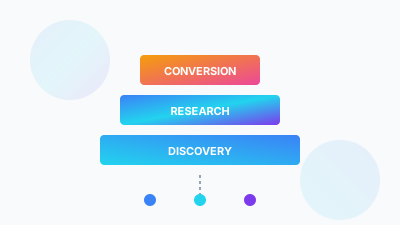
Sponsored Products drives the majority of most accounts' revenue. Structure it in three tiers:
Tier 1 — Discovery (Auto campaigns, low bids): One auto campaign per product category, targeting all four match types (loose match, close match, substitutes, complements). Bids at 40–60% of your target ACoS calculation. Purpose: harvest search terms Amazon's algorithm finds for you. These campaigns don't need to be profitable — they need to be efficient discovery engines. Review search terms weekly, promote winners to manual campaigns, add losers as negatives.
Tier 2 — Research (Manual broad and phrase campaigns): Keywords promoted from auto campaigns, plus manually researched terms with clear commercial intent. Broad match campaigns capture long-tail variations; phrase match narrows the intent. Bids at 60–80% of target ACoS. This tier is where discovery becomes profitable — you're still finding new search terms but with tighter control.
Tier 3 — Conversion (Manual exact campaigns): Only the exact-match search terms you know convert. Bids at 100–130% of target ACoS calculation because these placements convert reliably and you want to dominate them. These campaigns typically show the highest ACoS per campaign but the strongest overall account profitability, because you're paying premium bids only for guaranteed conversions.
The critical rule: no keyword lives in more than one tier at a time. When a search term proves profitable in your broad campaign, add it as an exact match in your conversion tier AND add it as a negative exact in the broad campaign. This prevents your own campaigns from bidding against each other — the single most common inefficiency in poorly structured accounts.
Sponsored Brands: The Category Ownership Play
Sponsored Brands isn't just a "brand awareness" tool — it's category real estate. The banner placements at the top of search results establish visual dominance that influences buying behavior even for searches that don't click your ad. Structure Sponsored Brands into two functions:
Category defense: Broad-match campaigns targeting category-defining terms ("kitchen storage," "office chairs," "wireless earbuds"). These campaigns often show high ACoS at the click level but generate substantial brand-search lift that's invisible in campaign reporting. Track the correlation between Sponsored Brands spend and branded search volume over 60-day windows — most brands see meaningful lift.
Competitor targeting: Exact-match campaigns targeting competitor brand names and top competitor ASINs. These are premium placements — you're paying to be seen by shoppers explicitly considering a competitor. ACoS on these campaigns is typically higher than category averages, but conversion rates are strong because the intent is already established.
Sponsored Brands Video deserves separate treatment. The unit economics differ substantially: higher CPC, higher engagement, better ROAS on cold traffic. Sellers with production capacity or budget for creative should run video as a separate campaign, not lumped in with static Sponsored Brands.
Sponsored Display: The Retargeting Layer
Sponsored Display gets underutilized because most sellers don't understand the two distinct campaign types it enables:
Product targeting (defensive and offensive): Ads that appear on specific ASIN detail pages. Defensive campaigns target your own detail pages to prevent competitor conquesting. Offensive campaigns target competitor detail pages to intercept their shoppers. Both are viable, but the strategic use case differs. Defensive spend is typically lower ACoS but harder to attribute value; offensive spend is higher ACoS but generates measurable share-of-voice against competitors.
Audience retargeting: Ads shown off-Amazon to shoppers who viewed your products but didn't purchase. This is one of the few Amazon advertising formats that reaches customers off-platform. ACoS calculations become tricky because attribution windows and off-Amazon conversion tracking are less reliable. Track incrementality by pausing retargeting for a 14-day test and measuring the resulting change in organic conversion rate.
Portfolio Structure: The Budget Governance Layer
Once you have a segmented campaign structure, group campaigns into portfolios that map to budget allocation strategy. Portfolios don't affect targeting — they're a budget management tool. But they're the difference between a controllable account and one that spends unpredictably.
Build portfolios that reflect real business logic: "Priority Products — Aggressive Growth," "Mature Products — Efficiency," "Defensive — Brand Protection," "Testing — New Launches." Assign campaigns based on which portfolio's strategy they serve. Set portfolio budget caps at 110–120% of intended spend so genuine daily spend spikes don't get throttled. Review portfolio-level performance weekly rather than campaign-level — this changes how you think about ROI at the account level.
Negative Keyword Architecture: The Under-Discussed Multiplier
Negatives determine which campaigns win which search terms. The two negative types work very differently:
Negative exact: Blocks the exact search term from the campaign. Use to prevent duplicate bidding across your campaigns (the tier-flow rule mentioned earlier) and to block confirmed non-converting terms.
Negative phrase: Blocks any search containing that phrase. Use aggressively for irrelevant intent — if you sell premium coffee, negative phrase "cheap" prevents ads on hundreds of search variations without individually specifying each. Powerful, but easy to over-restrict — audit negative phrases quarterly.
Maintain a shared negative keyword list across your account for terms that should never generate traffic (competitor brands you're not targeting, wrong product categories, obvious mismatches). Apply this list at the account level so new campaigns inherit the negatives automatically. Sellers who skip this end up manually adding "iphone" as a negative to 40 different Android accessory campaigns.
Bidding Strategy: Where Structure Enables Automation
Amazon offers three bidding strategies at the campaign level: dynamic bids up and down, dynamic bids down only, and fixed bids. Most sellers default to dynamic down without thinking through when each is appropriate.
Dynamic up and down: Amazon can raise your bid up to 100% for high-conversion likelihood placements. Use for conversion-tier exact match campaigns where you've validated conversion rate — you want Amazon raising your bid on high-probability placements.
Dynamic down only: Amazon lowers your bid for low-conversion likelihood placements, never raises. Use for discovery and research tier campaigns where you want to protect against overpayment on speculative placements.
Fixed bids: Your bid stays exactly where you set it. Use only for campaigns testing specific bid levels or where predictable spend is critical (defensive campaigns with strict budgets).
Placement Adjustments: The Detail That Compounds
Amazon shows ads in three placement types: Top of Search (page 1), Rest of Search (page 2+), and Product Pages. Each has different conversion characteristics. Top of Search converts 4–8x better than Product Pages for most categories but at 2–3x the click cost.
Set placement adjustments based on where your money actually converts. For conversion-tier campaigns, set Top of Search adjustment to +50% to +100% — you want the premium placement for keywords you know convert. For discovery campaigns, leave placement adjustments at 0% to let performance data emerge cleanly before optimizing.
The Weekly Optimization Rhythm
Structure enables discipline. With a segmented account, you can set predictable weekly rhythms: harvest new search terms from auto campaigns on Monday, promote/negate on Tuesday, review high-spend/low-conversion campaigns on Wednesday, adjust bids based on trailing 7-day performance on Thursday, review budget pacing and portfolio performance on Friday.
Without structure, you spend every day reacting to the campaign that broke first. With structure, you spend each day compounding improvements across campaigns that behave predictably. That difference — reactive vs proactive management — is what separates accounts that stagnate from accounts that scale profitably year over year.