The 82% Truth Most Sellers Don't Fully Grasp
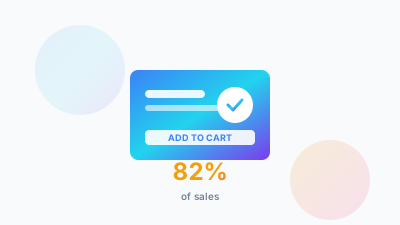
Roughly 82% of Amazon sales flow through the Buy Box — the "Add to Cart" and "Buy Now" buttons on a product detail page. If you're not in the Buy Box, you're competing for scraps: the 18% of customers who scroll to the "Other Sellers" section, most of whom are B2B buyers hunting for bulk deals or shoppers looking for a specific fulfillment method. For consumer-facing sellers, losing the Buy Box means losing the sale.
What most sellers get wrong is treating the Buy Box as a static prize you win once and hold. In reality, Amazon rotates Buy Box winners multiple times per day per ASIN based on a moving evaluation of price, fulfillment, seller performance, and inventory position. Two sellers with identical pricing and identical fulfillment will get different Buy Box shares — because the algorithm is factoring in things they don't see. Winning the Buy Box consistently means understanding what those hidden factors are.
Eligibility First: The Baseline That Locks Out Most Third-Party Sellers
Before we discuss winning, understand the eligibility gate. To even compete for the Buy Box, you need Professional selling plan status (not Individual), consistently strong seller performance metrics, and product category permissions. Newer sellers — those with less than 90 days of history or fewer than a few hundred completed orders — typically don't qualify regardless of how they price.
The specific thresholds Amazon uses aren't published, but our audits consistently find eligibility issues at these points: order defect rate above 1%, late shipment rate above 4%, valid tracking rate below 95%, or A-to-Z Guarantee claim rate above 0.15%. If your account exceeds any of these, Buy Box eligibility is compromised even if your pricing beats every competitor. Fix performance first, then optimize for winning.
The Real Ranking Factors: Beyond "Lowest Price Wins"
The persistent myth that Amazon's Buy Box goes to the lowest price is technically wrong and strategically dangerous. Price matters, but it's one of roughly seven weighted factors, and its weight varies by category, product velocity, and buyer type.
Fulfillment method: FBA and Seller Fulfilled Prime dramatically outweigh standard merchant fulfillment. In categories with active FBA competition, MFN sellers often can't win the Buy Box at any price. If you're competing against FBA sellers on a shared listing, either match with FBA yourself or accept that you'll rarely hold the Buy Box during peak buying hours.
Landed price (price + shipping): Amazon evaluates the total cost to the customer, not just item price. A seller charging $12 with $3 shipping loses to a seller charging $14 with free shipping. Sellers competing on merchant-fulfilled offers should almost always price with shipping included.
Handling time and delivery speed: Same-day and next-day delivery promises get preferential treatment. Sellers offering standard 3–5 day shipping lose Buy Box share during time-sensitive buying periods (evenings, weekends, holiday season).
Order defect rate and shipping performance: Sellers with stronger recent shipping performance win against sellers with identical pricing but weaker metrics. The algorithm weighs recent performance more heavily than historical — improving your metrics over 30 days can materially shift Buy Box share.
Inventory availability: Sellers running low on inventory (below Amazon's velocity-based threshold) lose Buy Box share to prevent stockouts. This is why sellers who "win" the Buy Box briefly at competitive pricing lose it once Amazon detects insufficient inventory to sustain the projected volume.
Seller feedback rating and count: A seller with 500 positive reviews at 4.9 stars will consistently win against a new seller with 20 reviews at 5.0 stars, all else equal. Volume of positive history matters.
Buyer segment: This is the least-discussed factor. Amazon serves different Buy Box winners to different buyer segments — Prime members, business buyers (Amazon Business), and buyers with prior category history may see different sellers in the Buy Box for the same ASIN.
Repricing Strategy: Rules-Based vs Algorithmic
Sellers competing on shared listings almost always need a repricer. The question is what kind. Rule-based repricers match or beat competitor pricing according to fixed rules ("match the lowest FBA competitor, minus 1 cent, but never below $18.50"). They're transparent and predictable but slow to react and easy for competitors to game once they figure out your rules.
Algorithmic repricers use Amazon's own signals — Buy Box share history, competitor behavior patterns, buyer segment data — to price dynamically. They tend to hold Buy Box share more consistently at higher prices because they raise prices when they detect they can win the Buy Box without discounting. The learning curve is longer, but the margin impact is often 5–12% higher net over 90 days.
Whatever repricer you use, set floor prices with rigor. The single most common failure mode we see is sellers setting floors too aggressively, then getting caught in downward spirals when competitors' repricers race each other to unsustainable levels. Your floor should reflect your true fully-loaded cost: COGS + FBA fees + advertising cost per sale + returns cost + margin target. Not "COGS plus 10%."
The Buy Box Suppression Trap
Sometimes no seller shows in the Buy Box — the listing displays "See All Buying Options" and every buyer has to click through to a comparison page. This is Buy Box suppression, and it destroys conversion rates. Amazon suppresses the Buy Box when they detect that no offer meets their price competitiveness threshold (typically calibrated against off-Amazon reference pricing) or when there's evidence of coordinated pricing among sellers.
If your ASIN has a suppressed Buy Box, your revenue on that listing has already dropped 40–60%. Investigate immediately. Check pricing against third-party sources (Walmart, Target, Best Buy for the exact product), competitor Amazon prices in adjacent regions, and MAP pricing you may be enforcing. In most cases, lowering price by 3–8% restores Buy Box eligibility. In some cases, Amazon requires you to prove sustainable pricing before restoring — a support case with documented cost structure evidence can accelerate resolution.
Winning Buy Box Share on Your Own Brand: The Different Challenge
Brand-registered sellers face different Buy Box dynamics. If you're the only seller on your ASIN, you effectively always win the Buy Box — until a hijacker lists against you. Hijackers typically appear during peak demand periods, offer prices 10–20% below yours, and steal Buy Box share until customers receive counterfeit or otherwise inferior product.
Prevent hijacking with Amazon Brand Registry, Transparency codes on high-risk products, and vigilant monitoring of your product detail pages. When a hijacker appears, don't try to compete on price — you'll destroy your own margin fighting inauthentic sellers. Instead, submit an infringement report through Brand Registry, purchase test units to document the counterfeit, and escalate to Amazon's brand protection team. Legitimate infringement claims resolve in 1–5 business days.
Buy Box for Multi-SKU Catalogs: The Portfolio Question
Sellers with hundreds or thousands of SKUs face a different strategic question: which ASINs to optimize for Buy Box aggressively vs which to let compete organically. High-margin, high-velocity ASINs deserve dedicated attention — dynamic repricing, close inventory management, prioritized advertising. Low-margin or slow-moving ASINs may not justify the operational overhead.
Segment your catalog by contribution margin and Buy Box percentage. ASINs contributing significant profit but holding less than 50% Buy Box share are your biggest opportunity — small improvements in Buy Box share translate directly to revenue. ASINs with 90%+ Buy Box share are already maximized; further optimization delivers diminishing returns.
How Fast Buy Box Position Actually Changes
Buy Box share updates in near real-time. A price change you make at 2:00 PM can begin affecting Buy Box share within 15–30 minutes. However, the algorithm's evaluation window smooths short-term fluctuations — a single price cut rarely produces immediate 100% Buy Box capture. Sellers frustrated by "why didn't I win after lowering price" often haven't waited long enough for the algorithm to update its weighted evaluation.
Track Buy Box share by hour of day. Most sellers find their Buy Box percentage varies significantly across the 24-hour cycle — winning during off-peak hours when competitors' repricers pause, losing during peak buying hours when the algorithm applies stricter evaluation. This pattern is often the biggest optimization opportunity: understanding when you lose Buy Box share tells you which competitors and which price points are actually blocking you.
The Buy Box Investment Framework
Buy Box wins have a real cost, and treating them like a "free" competitive lever leads to margin destruction. Every price cut is an investment — you're giving up margin now for volume that may or may not compensate.
The framework we use: calculate the incremental margin at proposed lower price, multiply by projected volume increase from Buy Box win, and compare to the margin at current price and current Buy Box share. Often a 3% price cut that raises Buy Box share from 40% to 75% delivers net higher profit. Just as often, a 10% price cut chasing 100% Buy Box share destroys unit economics.
Winning the Buy Box isn't the goal. Winning profitable share of the Buy Box is. Sellers who internalize this distinction consistently outperform sellers optimizing purely for Buy Box percentage.